The Timeline
Five centuries of ancient Stoicism and its later revivals, on one page.
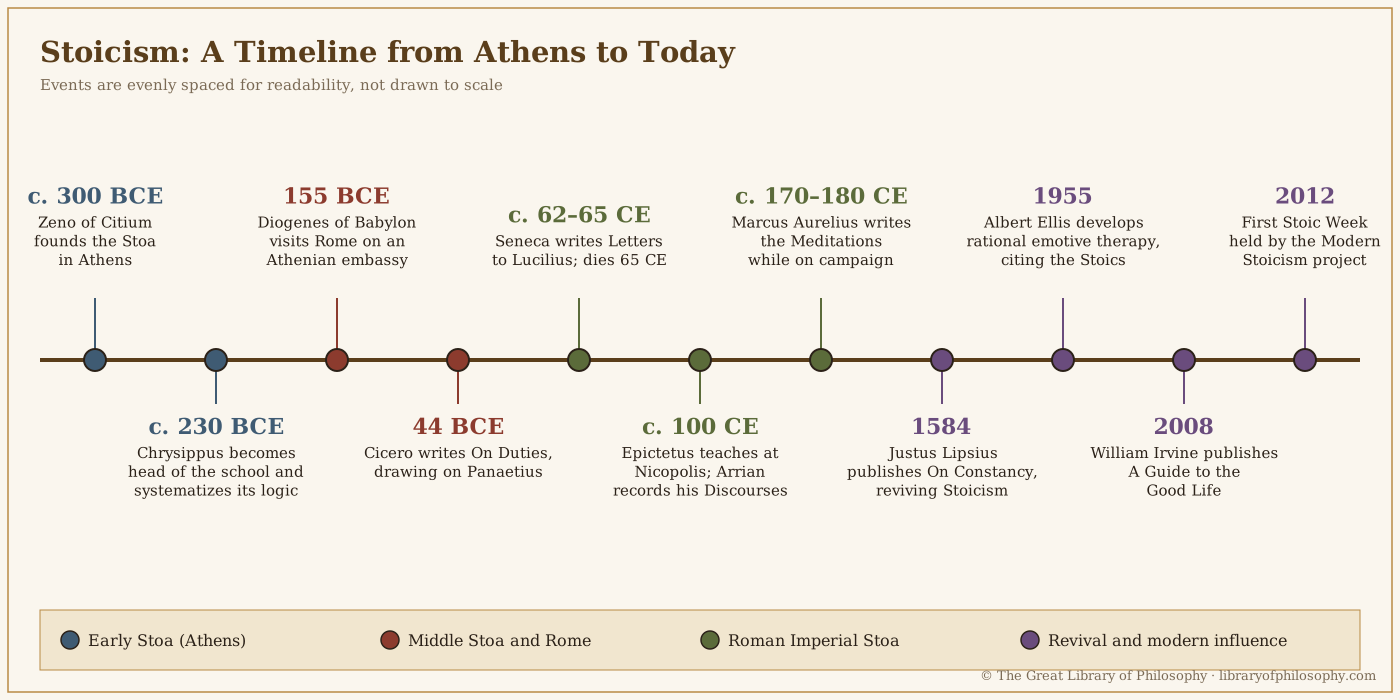
Key Dates in Text Form
The list below repeats the main dates for readers who use screen readers or prefer text. Ancient dates are approximate, and sources sometimes differ by a year or two (see the note on dates below).
Zeno of Citium, the founder of Stoicism, lives. Born in Citium on Cyprus, he later settles in Athens.[3]
Zeno begins teaching at the Stoa Poikile, or Painted Porch, in the Athenian agora. The school takes its name from the place.[3]
Cleanthes of Assos studies under Zeno and succeeds him as head of the school after Zeno's death.[3]
Chrysippus of Soli, third head of the school, systematises Stoic logic, physics and ethics and becomes the school's leading authority.[3]
The Academic sceptic Carneades challenges Stoic claims about knowledge, and Stoics such as Antipater of Tarsus respond. Panaetius brings Stoic ideas into closer contact with Platonic and Aristotelian thought.[1]
Cicero discusses Stoic doctrine in several philosophical works, helping to preserve it for Latin readers.[4]
Seneca writes essays and letters on virtue, anger, adversity and the use of time.[5]
Epictetus teaches that people should distinguish what is up to them from what is not. His lectures are recorded by his student Arrian.[6]
Marcus Aurelius, Roman emperor, writes the private reflections known as the Meditations.[7]
Justus Lipsius publishes De Constantia, a leading work in the Renaissance revival of Stoic ethics.[8]
Stoicism receives renewed attention in academic philosophy, virtue ethics and popular self-help. Comparisons with cognitive behavioural therapy are common, though the two are distinct.[9]
A Note on Dates
The dates associated with early Stoic philosophers should be treated as approximate rather than absolutely certain. Much of what is known about the early Stoics comes from surviving fragments, later philosophical writings, and biographical accounts written long after their lifetimes. As a result, historians sometimes disagree about the exact years in which particular philosophers were born or died.
For example, Zeno of Citium's death is commonly dated to around 262 or 263 BCE, while the dates associated with Chrysippus are generally given as approximately 280–206 or 279–206 BCE. Such differences reflect the limitations of the surviving historical evidence rather than necessarily indicating errors in modern scholarship.
Throughout this timeline, the abbreviation c. stands for circa, a Latin term meaning "approximately" or "around". It indicates that a date is estimated rather than established with complete certainty. Dates are presented using commonly accepted scholarly ranges, although different historical and reference works may use slightly different estimates.
We aim to present historical information as accurately and transparently as possible. If you notice a potentially incorrect date or have a reliable historical source that suggests a different estimate, please contact us through our contact page so that we can review it.
Using the Timeline in Teaching
This Stoicism timeline can be used as a one-page educational resource for introducing students to Hellenistic and Roman philosophy. It provides a chronological overview of the philosophers, historical developments and intellectual traditions that shaped Stoicism, making it easier to understand how the school developed over several centuries.
Students can use the timeline to compare the contributions of early Greek Stoics such as Zeno of Citium, Cleanthes and Chrysippus with those of later Roman thinkers such as Seneca, Epictetus and Marcus Aurelius. It also provides a starting point for exploring how Stoicism developed beyond its original setting in Athens and became influential throughout the Roman world.
The timeline can also support classroom discussions, historical comparisons and independent research. Some questions it can help students explore include:
- How did Stoicism change as it moved from Athens to Rome, and which of its central philosophical principles remained consistent?
- Why do we know more about the Roman Stoics through their surviving writings than about many of the early founders of the school?
- What were the main contributions of Zeno, Cleanthes and Chrysippus to the development of Stoic philosophy?
- How did Stoicism influence later philosophical traditions, and why did its ideas experience renewed interest in different historical periods?
- What differences can be observed between the concerns of early Greek Stoicism and those of Roman Stoic writers?
For further study, explore the complete article on Stoicism, the Stoic concept map, or the Stoicism Study Guide. Together, these resources provide a broader understanding of Stoic history, philosophical principles and major thinkers.
Reuse and Citation
You may share and adapt this timeline for non-commercial and educational use, including in classes, handouts, blog posts and study groups, provided you give credit and link back to this page. It is offered under the Creative Commons Attribution 4.0 licence.
Suggested credit line
"Stoicism Timeline" by Kavya Jain, The Great Library of Philosophy, https://libraryofphilosophy.com/stoicism-timeline.html
Suggested citation
Jain, Kavya. "Stoicism Timeline." The Great Library of Philosophy, 2026. https://libraryofphilosophy.com/stoicism-timeline.html.
If you use the timeline in a course or publication, we would be glad to hear about it through the contact page.
Sources
-
Baltzly, D. "Stoicism." Stanford Encyclopedia of Philosophy. plato.stanford.edu/entries/stoicism
-
Inwood, B., ed. The Cambridge Companion to the Stoics. Cambridge University Press, 2003.
-
Diogenes Laertius. Lives of Eminent Philosophers, Book 7, trans. R. D. Hicks. Loeb Classical Library, 1925.
-
Cicero. De Finibus, Book 3, and Academica.
-
Seneca. Letters on Ethics, trans. M. Graver and A. A. Long. University of Chicago Press, 2015.
-
Epictetus. Discourses, Fragments, Handbook, trans. R. Hard. Oxford World's Classics, 2014.
-
Marcus Aurelius. Meditations, trans. G. Hays. Modern Library, 2002.
-
Cooper, J. M. "Justus Lipsius and the Revival of Stoicism in Late-Sixteenth-Century Europe." In N. Brender and L. Krasnoff, eds., New Essays on the History of Autonomy, 7–29. Cambridge University Press, 2004.
-
Robertson, D. The Philosophy of Cognitive-Behavioural Therapy. Karnac, 2010.