Who Was Thomas Aquinas?
Thomas Aquinas was an Italian Dominican friar, philosopher, and theologian who lived from 1225 to 1274. He is remembered as one of the most systematically comprehensive and historically influential philosophers in the entire history of Western thought, whose monumental unfinished work, the Summa Theologica, sought to synthesize the rediscovered philosophy of Aristotle with the theological content of Christian doctrine into a single, coherent intellectual system.
Aquinas is especially associated with the conviction that faith and reason, properly understood, work in fundamental harmony rather than conflict, arguing that human reason, exercised carefully and rigorously, could establish significant philosophical truths about God and morality, while faith and divine revelation provided additional truths that exceeded, but did not contradict, what unaided reason alone could discover.
Trained within the newly founded Dominican order and educated under the influential philosopher Albert the Great, Aquinas produced an extraordinarily large body of systematic philosophical and theological writing during a relatively short career, engaging directly with major questions of metaphysics, ethics, natural theology, and political philosophy through his distinctive scholastic method of structured argument.
Because Aquinas's surviving body of work is so extensive and systematically comprehensive, historians of philosophy continue to study different facets of his thought from many distinct angles. His importance nonetheless remains foundational, since his synthesis of Aristotelian philosophy and Christian theology established Thomism as one of the most enduring and influential philosophical traditions in the subsequent history of Western thought.
Thomas Aquinas: Quick Facts
- Name — Thomas Aquinas (Doctor Angelicus)
- Period — 1225–1274
- Born in — Roccasecca, Kingdom of Sicily
- Died in — Fossanova Abbey, Italy
- Associated with — Scholasticism and Thomism
- Known for — The Summa Theologica and the Five Ways
- Major works — Summa Theologica and Summa Contra Gentiles
- Religious order — Dominican friar
- Key teacher — Albert the Great
- Historical importance — Most influential systematizer of Aristotelian-Christian philosophy in Western history
Aquinas and the Rise of Scholasticism
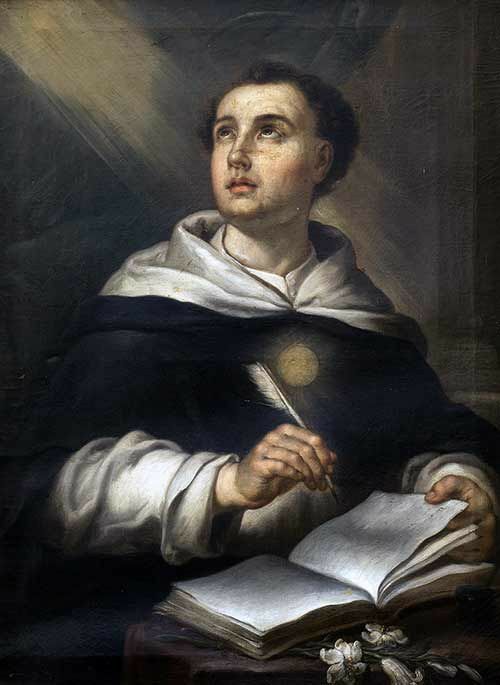
Aquinas's philosophical career unfolded during a pivotal period in medieval intellectual history, as the recently rediscovered complete philosophical corpus of Aristotle, transmitted to Western Europe partly through Arabic and Jewish philosophical commentary, generated intense excitement and significant theological controversy within the newly established medieval universities.
This period also saw the emergence of the mendicant religious orders, including the Dominicans, to which Aquinas belonged, dedicated to combining rigorous intellectual training with active preaching and pastoral engagement, an institutional context that shaped Aquinas's own approach to combining serious philosophical scholarship with theological and pastoral purpose.
Aquinas's own project of systematically reconciling Aristotelian philosophy with Christian theology addressed genuine and significant theological anxieties of his era, since some contemporary theologians worried that Aristotle's philosophy, particularly as transmitted through certain Arabic commentators, contained conclusions difficult to reconcile with orthodox Christian doctrine.
Aquinas's Early Life and Entry into the Dominican Order
Aquinas was born into a noble family in Roccasecca, in the Kingdom of Sicily, and was initially sent as a young boy to the nearby monastery of Monte Cassino, where his family hoped he might eventually rise to a prestigious position within the traditional Benedictine monastic order, reflecting his family's considerable social standing and ambition.
Against his family's explicit wishes, Aquinas instead chose to join the recently founded and considerably less socially prestigious Dominican order, a decision that reportedly provoked such strong family opposition that his own brothers forcibly detained him for approximately a year in an attempt to change his mind, an episode illustrating the considerable personal conviction underlying his religious vocation.
Aquinas eventually succeeded in joining the Dominicans despite this determined family resistance, beginning a religious and intellectual formation that would shape the remainder of his relatively brief but extraordinarily productive life, combining rigorous philosophical study with the Dominican order's distinctive emphasis on preaching and public intellectual engagement.
Aquinas's Education Under Albert the Great
Aquinas received crucial philosophical training under Albert the Great, one of the most learned and influential philosophers and theologians of his generation, who recognized Aquinas's exceptional intellectual gifts and provided essential early guidance in the careful integration of Aristotelian philosophy with Christian theological inquiry.
Albert's own extensive scholarly engagement with Aristotelian natural philosophy and metaphysics provided the essential intellectual foundation upon which Aquinas would build his own, considerably more systematic and comprehensive philosophical and theological synthesis, and Albert remained a significant mentor and intellectual influence throughout Aquinas's subsequent career.
This formative relationship between Aquinas and Albert the Great illustrates the collaborative and cumulative character of medieval scholastic philosophy, in which successive generations of teachers and students built systematically upon one another's work in developing an increasingly sophisticated synthesis of classical philosophy and Christian theology.
Aquinas's Academic Career at Paris
Aquinas held teaching positions at the University of Paris, then the most prestigious center of theological and philosophical education in medieval Europe, where he engaged directly with major contemporary theological controversies while producing the bulk of his extensive systematic philosophical and theological writing.
During his time in Paris, Aquinas found himself engaged in significant intellectual disputes, including debates over the proper interpretation of Aristotelian philosophy and its compatibility with Christian doctrine, controversies that would eventually contribute to posthumous ecclesiastical scrutiny of several positions closely associated with his broader philosophical system.
Aquinas's remarkably productive academic career, combining teaching, preaching, and prolific systematic writing, produced an enormous body of philosophical and theological work within a relatively compressed timeframe, reflecting both his exceptional intellectual capacity and his consistent dedication to the Dominican order's mission of rigorous intellectual engagement in service of Christian teaching.
What Did Aquinas Believe?
Aquinas's philosophy rests on the foundational conviction that faith and reason represent two complementary and ultimately harmonious paths toward truth, since both originate, in Aquinas's theological framework, from the same divine source, meaning that genuine philosophical reasoning could never, when conducted correctly, arrive at conclusions genuinely contradicting authentic Christian revelation.
Central to this philosophy is Aquinas's extensive adaptation of Aristotelian metaphysics and natural philosophy, particularly Aristotle's framework of form and matter, potency and act, and the four causes, which Aquinas employed systematically to address distinctly Christian theological questions concerning creation, the soul, and the nature of God.
Aquinas also developed an influential and comprehensive natural law ethical theory, arguing that human reason, by carefully reflecting on the natural inclinations and purposes built into human nature, could discover genuine moral principles accessible in principle to all rational beings, independent of religious revelation, even while remaining fully compatible with and completed by Christian moral teaching.
Scholars of medieval philosophy continue to study the considerable technical complexity of Aquinas's metaphysical and theological system, given its extraordinary systematic scope, but his overall philosophical achievement is consistently recognized as one of the most influential and comprehensive syntheses ever produced within the history of Western philosophy.
Summa Theologica: Aquinas's Masterwork
The Summa Theologica, Aquinas's monumental and ultimately unfinished major work, presents an extraordinarily systematic treatment of the whole of Christian theology and philosophy, organized through the distinctive scholastic method of posing precise questions, presenting objections, and offering carefully reasoned responses addressing each objection in turn.
The work is organized into three major parts, addressing successively the nature of God and creation, human moral action and the path toward genuine happiness, and the person and work of Christ, together constituting one of the most comprehensive systematic treatments of theology and philosophy ever attempted within a single unified intellectual project.
Despite remaining unfinished at the time of Aquinas's death, the Summa Theologica became the single most influential text within the subsequent Thomist philosophical and theological tradition, continuing to be studied intensively within Catholic theology and academic philosophy as one of the most systematically comprehensive works ever produced in the history of Western thought.
The Five Ways: Aquinas's Proofs for God's Existence
The Five Ways, presented near the beginning of the Summa Theologica, comprise Aquinas's five distinct philosophical arguments for the existence of God, each proceeding from a different observed feature of the natural world, including motion, efficient causation, contingency, degrees of perfection, and the apparent purposeful order exhibited by natural, non-intelligent things.
Each argument follows a broadly similar structure, observing a particular feature of the natural world and arguing that this feature could not be adequately explained without ultimately appealing to a first cause, necessary being, or intelligent orderer that Aquinas identifies, in each case, with what "everyone understands to be God," treating these arguments as demonstrating God's existence through natural reason alone.
The Five Ways remain among the most widely studied and extensively debated arguments in the entire history of philosophy of religion, continuing to generate significant scholarly discussion concerning their precise logical structure, their philosophical validity, and their relationship to Aristotelian metaphysical concepts including potentiality, actuality, and causation.
Aquinas and Aristotle: Christianizing Aristotelian Philosophy
Aquinas's most historically significant achievement lies in his systematic integration of Aristotelian philosophy into a comprehensive Christian theological framework, adapting Aristotle's metaphysics, natural philosophy, and ethics to address distinctly Christian theological questions while preserving much of Aristotle's own underlying philosophical method and conceptual vocabulary.
This synthesis required Aquinas to carefully navigate several significant tensions between Aristotelian philosophy and Christian doctrine, including Aristotle's apparent belief in the eternity of the world, which Aquinas addressed through careful philosophical distinction between what reason alone could establish and what required additional grounding in Christian revelation regarding creation.
Through this careful and systematic integration, Aquinas transformed Aristotelian philosophy from a potentially threatening pagan intellectual system into an essential and enduring intellectual resource for Christian theology, a transformation that decisively shaped the subsequent development of medieval and later Catholic philosophy for centuries afterward.
Natural Law Theory: Aquinas's Ethics
Aquinas's influential natural law theory holds that moral principles can be discovered through careful rational reflection on the natural inclinations and purposes built into human nature itself, including fundamental inclinations toward self-preservation, reproduction and the raising of children, the pursuit of knowledge, and life within organized society.
According to this framework, genuinely moral action consists in acting in accordance with these natural human inclinations understood rationally and directed toward their proper, fulfilling ends, providing a philosophical foundation for ethics that Aquinas argued remained accessible in principle to any rational person through careful reflection, independent of specific religious revelation.
Natural law theory proved enormously influential well beyond Aquinas's own immediate theological context, shaping subsequent Catholic moral theology extensively while also significantly influencing the later development of secular political and legal philosophy, including foundational concepts within modern human rights theory and international law.
The Doctrine of Analogy: How We Can Speak About God
Aquinas developed an influential doctrine of analogy to address the difficult philosophical question of how finite human language, developed to describe ordinary created things, could meaningfully be applied to an infinite, transcendent God without either falsely implying that divine attributes are identical in meaning to their human counterparts or, alternatively, reducing such language to complete equivocation and meaninglessness.
Aquinas argued that terms applied to both God and creatures, such as "good" or "wise," function neither univocally, with exactly identical meaning in both cases, nor purely equivocally, with entirely unrelated meanings, but instead analogically, preserving a genuine, meaningful relationship between the human and divine sense of the term while acknowledging the infinite qualitative difference between finite creatures and their infinite creator.
This doctrine of analogy proved philosophically significant for addressing broader questions in philosophy of religion concerning religious language and the possibility of meaningful theological discourse, continuing to be studied and debated by contemporary philosophers of religion examining how finite language can meaningfully refer to transcendent divine reality.
Aquinas on Faith and Reason
Aquinas maintained that faith and reason represent distinct but fundamentally complementary sources of genuine knowledge, arguing that certain religious truths, including God's existence, could in principle be established through careful philosophical reasoning alone, while other truths, including the doctrine of the Trinity, required additional grounding in divine revelation accepted through faith.
According to this framework, genuine philosophical reasoning, when conducted correctly and rigorously, could never actually contradict authentic religious truth, since both ultimately originate from the same divine source, meaning that any apparent conflict between philosophy and theology, in Aquinas's view, must reflect an error in reasoning somewhere along the way rather than a genuine, irresolvable contradiction between the two.
This carefully balanced position on the relationship between faith and reason established an influential model for subsequent Catholic intellectual tradition, allowing serious philosophical inquiry to flourish within a religious theological framework without treating philosophy as either entirely subordinate to theology or as an independent, potentially threatening rival source of ultimate truth.
Aquinas on the Soul and Hylomorphism
Aquinas adopted and adapted the Aristotelian doctrine of hylomorphism, according to which every physical substance consists of both matter and form, applying this framework to argue that the human soul functions as the substantial form of the human body, providing the organizing principle that makes a living human body genuinely alive and capable of characteristically human activities including rational thought.
Unlike more strictly dualist accounts of the soul as an entirely independent substance merely temporarily housed within the body, Aquinas's hylomorphic account treats the soul and body as intimately and naturally united, while still maintaining, in keeping with Christian doctrine, that the human rational soul possesses a distinctive capacity to exist and continue after the body's death, unlike the souls of non-rational animals.
This distinctive philosophical position on the soul allowed Aquinas to affirm both a genuinely unified conception of the human person as a single integrated substance and the Christian theological doctrine of personal immortality and eventual bodily resurrection, navigating a philosophically sophisticated middle path between strict materialism and strict dualism.
Aquinas on Virtue Ethics and the Cardinal and Theological Virtues
Aquinas developed an extensive and systematic account of virtue, integrating the four classical cardinal virtues inherited from Greek philosophy, namely prudence, justice, fortitude, and temperance, with the three specifically Christian theological virtues of faith, hope, and charity, into a single comprehensive account of human moral and spiritual development.
Aquinas argued that the cardinal virtues could, in principle, be developed through natural human effort and habituation alone, while the theological virtues required the direct infusion of divine grace, since they oriented the human person toward a supernatural end, namely union with God, that exceeded what purely natural human capacities could achieve independently.
This integrated account of virtue proved philosophically significant for connecting classical philosophical ethics with distinctly Christian theological concerns, establishing a comprehensive framework for moral and spiritual development that continues to inform contemporary Catholic moral theology and broader philosophical discussions of virtue ethics.
Aquinas on Just War Theory
Building directly on the earlier reflections of Saint Augustine, Aquinas developed a more systematic account of the conditions under which armed conflict could be morally justified, requiring that a just war be declared by legitimate political authority, conducted for a genuinely just cause, and pursued with the proper underlying intention of promoting good or avoiding evil rather than mere aggression or material gain.
Aquinas's systematic treatment of just war criteria, presented within the broader ethical framework of the Summa Theologica, helped establish a more formally structured version of just war theory than Augustine's earlier, more scattered reflections had provided, distinguishing carefully between the conditions justifying the initial resort to war and the proper conduct of war once undertaken.
This systematic treatment of just war theory proved highly influential for the subsequent development of international law and military ethics, continuing to shape contemporary discussions of the moral justification for armed conflict and the proper limits on conduct during war within both religious and secular ethical traditions.
Aquinas on Free Will and Moral Responsibility
Aquinas maintained that human beings possess genuine free will, understood as the rational capacity to deliberate about different possible courses of action and to choose among them based on reasoned judgment about what constitutes genuine good, a capacity Aquinas considered essential for meaningful moral responsibility and praise or blame for human action.
Aquinas's account of free will connects closely to his broader intellectualist psychology, arguing that the will necessarily follows the intellect's judgment about what constitutes the good in a given situation, while still maintaining genuine freedom in the will's capacity to direct attention toward different considerations and to ultimately determine which judged good to actually pursue in concrete action.
This carefully developed account of free will and moral responsibility proved significant for Aquinas's broader ethical and theological system, providing the necessary philosophical foundation for his extensive treatment of virtue, sin, and moral responsibility throughout the Summa Theologica.
The Doctrine of Transubstantiation
Aquinas provided the most philosophically sophisticated and historically influential explanation of the Catholic doctrine of transubstantiation, employing Aristotelian metaphysical categories of substance and accident to explain how the bread and wine of the Eucharist could be believed to undergo a complete change of underlying substance into the body and blood of Christ while retaining all their outward physical appearances and properties.
Aquinas argued that the accidental properties of the bread and wine, including their taste, appearance, and physical characteristics, remain genuinely unchanged even as their underlying substance is transformed, a philosophically sophisticated application of Aristotelian metaphysics to a distinctly Christian theological question that became the official Catholic theological explanation of this central sacramental doctrine.
This application of Aristotelian metaphysical categories to Eucharistic theology illustrates Aquinas's characteristic method of employing careful philosophical analysis to clarify and systematically articulate Christian theological doctrine, demonstrating the practical theological utility of his broader Aristotelian-Christian philosophical synthesis.
Aquinas on Happiness and the Beatific Vision
Aquinas developed an extensive philosophical account of human happiness, adopting and adapting Aristotle's eudaimonistic framework while arguing that genuine and complete human happiness cannot ultimately be achieved through any finite created good, including wealth, honor, power, or even philosophical knowledge, but only through direct, complete knowledge of God, what Aquinas called the beatific vision.
According to this account, the beatific vision, understood as the direct intellectual apprehension of God's own essence, represents the ultimate and only fully satisfying object of human desire and intellectual capacity, an end that exceeds what human beings could achieve through natural effort alone and requires divine grace to attain, connecting Aquinas's philosophical account of happiness directly to his broader theological framework.
This account of happiness carries significant implications for Aquinas's broader ethical system, since it grounds the ultimate purpose and orientation of human moral and intellectual development in this final supernatural end, treating all lesser finite goods as valuable primarily insofar as they contribute to or remain compatible with this ultimate and complete human fulfillment.
Aquinas's Doctrine of Being: Essence and Existence
Aquinas developed a distinctive and historically influential metaphysical distinction between essence, what a thing fundamentally is, and existence, the actual fact that a thing exists, arguing that in every created being these two remain genuinely distinct, since a thing's essence alone never logically guarantees that it must actually exist.
Aquinas argued that God alone represents the singular exception to this distinction, since God's essence and existence are identical, meaning that God simply is existence itself rather than a being whose existence must be caused or explained by something external, a metaphysical claim central to Aquinas's broader natural theology and his account of God's absolute metaphysical uniqueness and simplicity.
This distinction between essence and existence proved philosophically significant for subsequent metaphysics, providing a technical framework for explaining why created beings depend continuously on an external cause for their existence, connecting directly to several of the arguments Aquinas develops within his broader Five Ways proofs for God's existence.
Aquinas and the Condemnations of 1277
Several years after Aquinas's death, in 1277, the Bishop of Paris issued a formal condemnation of numerous philosophical propositions circulating within the university, some of which were closely associated with, or interpreted as implicating, aspects of Aquinas's own philosophical system, particularly regarding certain of his more distinctly Aristotelian positions on the nature of the soul and the limits of divine power.
This posthumous controversy reflected broader theological anxiety concerning the proper limits of philosophical reasoning within Christian theology, illustrating that even Aquinas's own carefully constructed synthesis of Aristotelian philosophy and Christian doctrine did not entirely escape suspicion from more theologically conservative contemporaries concerned about the potential dangers of excessive philosophical confidence.
Aquinas's reputation and philosophical standing recovered significantly in the following decades, and he was formally canonized as a saint in 1323, after which his philosophical system gradually achieved the position of preeminent authority within Catholic theology that it would continue to hold for many subsequent centuries.
Aquinas's Mystical Experience and Unfinished Summa
According to traditional accounts, Aquinas underwent an intense mystical experience in December 1273, following which he reportedly ceased his prolific systematic writing entirely, famously remarking to a close companion that everything he had written now seemed to him like straw compared to what had been revealed to him during this profound spiritual experience.
This dramatic cessation of writing left the Summa Theologica permanently unfinished, with its final sections on the sacraments and last things later completed by later editors drawing on Aquinas's earlier writings, a poignant conclusion to one of the most systematically ambitious philosophical and theological projects ever attempted.
Aquinas died only a few months later, in March 1274, while traveling to attend a church council, bringing to a close a relatively brief but extraordinarily productive intellectual career whose final mystical episode continues to be studied and discussed as a significant and somewhat enigmatic conclusion to his otherwise extensively documented philosophical and theological life.
Aquinas Compared with Augustine
Aquinas's philosophical method, centered on systematic Aristotelian categories and a carefully structured scholastic method of question and reasoned response, differs considerably in style and philosophical inspiration from the earlier work of Saint Augustine, whose writing drew more heavily on Platonic and Neoplatonic philosophy and proceeded through personal reflection and theological argument rather than formal systematic structure.
Despite these significant methodological and philosophical differences, Aquinas held Augustine's theological authority in extremely high regard, citing him extensively throughout his own major works and building directly on several of Augustine's key theological positions, including his treatment of divine grace, even while developing these positions within his own, considerably more systematically Aristotelian philosophical framework.
This relationship between Aquinas and Augustine illustrates a significant and historically consequential transition within medieval philosophy, from the earlier Augustinian-Platonic synthesis that had dominated much of early medieval Christian thought toward the more systematically Aristotelian approach that Aquinas's own work would establish as the dominant framework for subsequent Catholic philosophy.
Aquinas Compared with Duns Scotus and Ockham
Aquinas's philosophical synthesis faced significant subsequent challenge from later medieval philosophers, including Duns Scotus, whose subtle metaphysical distinctions and voluntarist theology diverged in several important respects from Aquinas's own more strongly intellectualist and Aristotelian philosophical framework.
William of Ockham, writing somewhat later, developed an even more thoroughgoing critique of several Thomistic metaphysical positions, particularly regarding the reality of universals, applying his principle of explanatory economy to reject several of the more elaborate metaphysical distinctions that Aquinas's Aristotelian realism had employed.
This progression from Aquinas through Scotus to Ockham illustrates a significant and historically important trajectory within later medieval scholastic philosophy, moving gradually from Aquinas's confident Aristotelian realism and rationalism toward increasingly nominalist and voluntarist positions that would eventually contribute to significant currents within early modern philosophy.
Common Misconceptions About Aquinas
One persistent misconception treats Aquinas as having simply adopted Aristotelian philosophy wholesale without significant critical modification, overlooking the extensive and often quite technical philosophical work Aquinas undertook to adapt and, in several significant respects, substantially revise Aristotelian concepts to accommodate distinctly Christian theological requirements.
Another common misconception assumes that Aquinas's Five Ways were intended as fully independent, free-standing philosophical demonstrations addressed to religious skeptics, when they actually appear within the broader theological structure of the Summa Theologica, addressed primarily to an audience of Christian theological students already operating within a shared framework of religious commitment.
A further misconception treats Aquinas's philosophical system as static and monolithic, overlooking the considerable subsequent scholarly debate and internal diversity within the later Thomist tradition regarding how best to interpret and apply various specific elements of his extraordinarily extensive and systematically comprehensive body of philosophical and theological writing.
Aquinas's Legacy: Thomism and Modern Catholic Philosophy
Aquinas's philosophical and theological system, known as Thomism, became the officially favored philosophical framework within Catholic theology, particularly following Pope Leo XIII's 1879 encyclical explicitly recommending Aquinas's philosophy as the preeminent guide for Catholic theological and philosophical education.
This official endorsement helped establish an enduring and continuously developing tradition of Thomist scholarship that continues to the present day, with contemporary Thomist philosophers applying and adapting Aquinas's core philosophical insights to address distinctly modern philosophical questions in metaphysics, ethics, and philosophy of religion.
Beyond specifically Catholic theological contexts, Aquinas's philosophical contributions, particularly his natural law theory and his metaphysical arguments, continue to be studied seriously within secular academic philosophy, securing his position as one of the most historically significant and continuously influential philosophers in the entire history of Western thought.
Thomas Aquinas: Main Philosophical Ideas
Because Aquinas's philosophical output is so extensive and systematically comprehensive, his central ideas are often summarized under a small number of key themes drawn from across his extraordinarily large surviving body of work.
Harmony of Faith and Reason
Aquinas held that genuine philosophical reasoning and authentic Christian revelation could never truly contradict one another.
The Five Ways
Aquinas developed five distinct philosophical arguments for God's existence based on features of the observed natural world.
Natural Law Ethics
Moral principles can be discovered through rational reflection on the natural inclinations and purposes built into human nature.
The Aristotelian-Christian Synthesis
Aquinas systematically integrated Aristotelian philosophy into a comprehensive Christian theological framework.
Human Happiness in the Beatific Vision
Complete human happiness can only be achieved through direct knowledge of God, exceeding what any finite created good can provide.
What Do We Actually Know About Aquinas's Philosophy?
Because Aquinas's extensive published writing survives in considerable detail, alongside substantial documentary evidence concerning his career and the subsequent history of his reception, his intellectual biography is relatively well established for a medieval figure, though certain specific biographical episodes, particularly his final mystical experience, remain less fully documented.
Relatively Well-Attested
- Aquinas was born in Roccasecca around 1225 and died at Fossanova Abbey in 1274.
- He studied under Albert the Great and later taught at the University of Paris.
- He authored the Summa Theologica and the Summa Contra Gentiles, among many other works.
- He was canonized as a saint in 1323.
- Several propositions associated with his philosophy were examined in the 1277 condemnations at Paris.
Areas of Ongoing Scholarly Debate
- How precisely to interpret the philosophical structure and intended audience of the Five Ways.
- The exact nature and significance of his final mystical experience and its relationship to his unfinished Summa.
- How different schools within the later Thomist tradition should interpret specific elements of his metaphysics and ethics.
Why Is Thomas Aquinas Important in Philosophy?
Aquinas is important because he produced one of the most systematically comprehensive and historically influential syntheses of classical philosophy and Christian theology ever written, establishing Thomism as an enduring philosophical tradition that continues to shape Catholic theology and academic philosophy today.
His philosophical legacy raises a fundamental question that remains central to philosophy of religion: Can human reason, exercised independently of religious revelation, establish significant philosophical truths about God and morality, and if so, how do these rational truths relate to truths accepted through religious faith?
Aquinas's importance therefore does not depend on resolving every scholarly debate about the interpretation of his extraordinarily extensive body of work. His significance comes from his role in establishing an enduring model for integrating rigorous philosophical reasoning with religious conviction, a legacy that continues to shape Western philosophy and theology today.
Thomas Aquinas Explained Simply
Thomas Aquinas was a medieval Italian philosopher and Dominican friar whose Summa Theologica combined Aristotelian philosophy with Christian theology, developing the Five Ways proving God's existence and a natural law theory of ethics accessible to human reason.
Instead of treating philosophy and theology as separate or competing domains, Aquinas's work insists that faith and reason work in fundamental harmony, using careful, systematic argument to address questions ranging from the existence of God to the nature of human happiness and virtue.
- Philosopher: Thomas Aquinas
- Period: 1225–1274
- Tradition: Scholasticism and Thomism
- Major work: Summa Theologica
- Central concern: The harmony of faith and reason
- Key contribution: The Five Ways and natural law theory
A Principle Central to Aquinas's Philosophy
“Grace does not destroy nature, but perfects it.”
Frequently Asked Questions About Thomas Aquinas
Who was Thomas Aquinas?
Thomas Aquinas was a thirteenth-century Italian Dominican friar and philosopher whose Summa Theologica synthesized Aristotelian philosophy with Christian theology, developing the Five Ways, natural law theory, and a lasting influence on Western philosophy.
What are the Five Ways?
The Five Ways are Aquinas's five arguments for the existence of God, based on motion, causation, contingency, degrees of perfection, and the apparent purposeful order found in nature.
What is Aquinas's natural law theory?
Aquinas's natural law theory holds that moral principles can be discovered through reason by reflecting on human nature's built-in inclinations toward self-preservation, reproduction, knowledge, and social life, providing a rational foundation for ethics accessible to all people.
What is the Summa Theologica about?
The Summa Theologica is Aquinas's monumental, unfinished work systematically addressing the whole of Christian theology and philosophy, organized through structured questions, objections, and reasoned responses.
How did Aquinas combine faith and reason?
Aquinas argued that faith and reason are complementary paths to truth originating from the same divine source, so that genuine philosophical reasoning could never truly contradict authentic Christian revelation.
What is the doctrine of analogy?
The doctrine of analogy explains how finite human language can meaningfully describe an infinite God, holding that terms like "good" apply to both God and creatures neither identically nor with unrelated meanings, but analogically.
What is hylomorphism in Aquinas's philosophy?
Hylomorphism, adapted from Aristotle, holds that the human soul is the substantial form of the body, uniting soul and body as a single integrated substance rather than two separate things.
Why did Aquinas stop writing before finishing the Summa?
According to tradition, Aquinas experienced an intense mystical experience in 1273 after which he stopped writing, reportedly saying his previous work now seemed like straw compared to what had been revealed to him.
How is Aquinas different from Augustine?
Augustine's philosophy drew more heavily on Platonism and personal reflection, while Aquinas developed a more systematically Aristotelian framework using the structured scholastic method of question and reasoned response.
Why is Aquinas important today?
Aquinas remains important because Thomism continues to shape Catholic theology, and his natural law theory and metaphysical arguments remain seriously studied within secular academic philosophy today.
Related Thinkers
Thomas Aquinas belongs to the wider tradition of medieval scholastic philosophy. Explore thinkers who shaped and responded to many of the same questions about God, knowledge, and ethics.
Philosophy Branches Connected to Aquinas
Aquinas's philosophical legacy is particularly important for metaphysics, where his arguments for God's existence remain widely studied, and for ethics, which continues to draw on his natural law theory.
Why Thomas Aquinas Still Matters
Aquinas did not simply inherit the philosophical and theological traditions available to him; he fused Aristotelian philosophy and Christian theology into a genuinely original and systematically comprehensive synthesis capable of addressing questions of God, ethics, and human nature with a depth that few later thinkers have matched.
Yet the questions associated with Aquinas remain fundamental to philosophy: Can reason alone establish God's existence? What does human nature reveal about how we should live? How should faith and philosophical reasoning relate to one another?
The philosophy he developed across a relatively brief but extraordinarily productive career transformed these questions into one of the richest and most enduring bodies of thought in the history of Western philosophy. His emphasis on the harmony of faith and reason, natural law, and the Five Ways made Thomas Aquinas one of the most significant and lastingly influential philosophers in human history.
Explore Great Philosophers