Who Was Cicero?
Cicero, in full Marcus Tullius Cicero, was a Roman statesman, lawyer, orator, and philosopher who lived from 106 to 43 BCE. He is best known for translating Greek philosophical ideas into Latin for the first time on a large scale, for developing an influential theory of natural law, and for major works including De Officiis, De Republica, and De Legibus that shaped Western political and moral philosophy for over two thousand years.
Cicero is especially associated with the conviction that genuine law and morality rest on universal principles of reason accessible to every human being, rather than merely on the arbitrary decisions of particular rulers or societies, a conviction he expressed through his famous claim that true law is "right reason in agreement with nature."
Trained as a lawyer and rising to the highest political office of consul in the Roman Republic, Cicero combined an active public career in law and politics with an extraordinarily prolific output of philosophical writing, composing many of his most significant works during periods of enforced political retirement, and consistently working to make Greek philosophical ideas accessible to a Latin-speaking Roman audience.
Cicero's importance rests on three distinct contributions: his creation of a working Latin philosophical vocabulary that later European philosophy would continue to use, his systematic theory of natural law that influenced legal and political thought from Roman times through the American founding, and his surviving speeches and letters, which remain primary sources for understanding the final decades of the Roman Republic.
Cicero: Quick Facts
- Name — Marcus Tullius Cicero
- Period — 106–43 BCE
- Born in — Arpinum, Roman Republic (present-day Arpino, Italy)
- Died in — Formia, Roman Republic
- Associated with — Natural law theory and Roman eclectic philosophy
- Known for — Translating Greek philosophy into Latin and developing natural law theory
- Major works — De Officiis, De Republica, and De Legibus
- Political role — Consul of Rome in 63 BCE
- Notable event — Exposed the Catiline conspiracy against the Roman state
- Cause of death — Executed on the order of the Second Triumvirate for opposing Mark Antony
What Period Did Cicero Live In?
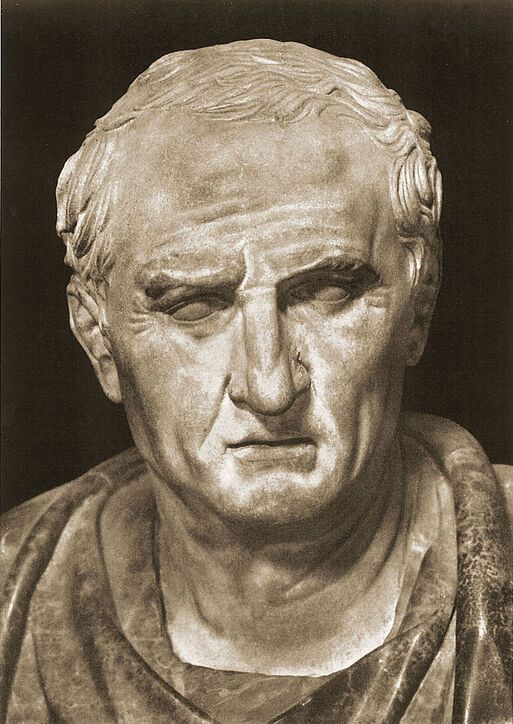
Cicero lived through the final and most politically turbulent decades of the Roman Republic, a period marked by escalating civil conflict, the rise of powerful individual generals including Julius Caesar and Pompey, and the gradual collapse of traditional republican political institutions that would culminate, shortly after Cicero's own death, in the establishment of the Roman Empire under Augustus.
This period also saw significant Roman engagement with Greek philosophy, as educated Romans increasingly studied and adapted Greek philosophical schools, including Stoicism, Epicureanism, and Academic Skepticism, though most serious philosophical texts still existed only in Greek, creating exactly the gap Cicero's own translation project would address.
Cicero's own political career and eventual violent death were directly shaped by this broader political collapse, as his consistent defense of traditional republican government placed him in direct and ultimately fatal conflict with the increasingly dominant individual strongmen, including Mark Antony, who were reshaping Roman politics around personal military power rather than republican institutions.
What Was Cicero's Early Life Like?
Cicero was born in Arpinum, a hill town southeast of Rome, into a wealthy local family that lacked the noble ancestry of Rome's traditional aristocracy, making him what Romans called a "new man," someone who would need to establish his own political standing through personal achievement rather than inherited family reputation.
Cicero received an extensive education in rhetoric, law, and philosophy, studying under leading teachers in Rome and later traveling to Greece to study directly with philosophers representing the Academic, Stoic, and Epicurean schools, an education that gave him unusually direct, firsthand exposure to the full range of contemporary Greek philosophical thought.
This combination of rhetorical training and direct philosophical study equipped Cicero with both the practical skills needed for a successful legal and political career and the intellectual grounding that would later support his extensive philosophical writing, establishing the foundation for his distinctive later role as a bridge between Greek philosophy and Roman public life.
What Did Cicero Do as Consul?
Cicero was elected consul, the highest political office in the Roman Republic, in 63 BCE, a significant achievement for a "new man" without noble ancestry, and during his consulship he became famous for exposing and suppressing the Catiline conspiracy, a plot led by the senator Lucius Sergius Catilina to violently overthrow the Roman government.
Cicero delivered a series of dramatic speeches before the Roman Senate, known as the Catilinarian Orations, publicly denouncing Catiline and his fellow conspirators and securing the authority to take decisive action against them, an episode that established Cicero's lasting reputation as a defender of the Roman republican constitution against internal threats.
This decisive action, while securing Cicero's short-term political triumph and considerable public acclaim, also generated lasting political controversy, since his execution of Roman citizens without full formal trial provided political opponents with grounds for later legal and political attack, including his eventual temporary exile from Rome.
What Did Cicero Believe?
Cicero believed that genuine law and morality rest on universal principles of reason built into nature itself and accessible to every human being, rather than on the arbitrary decisions of particular rulers, a conviction that grounds his influential theory of natural law and his broader political philosophy.
Cicero did not commit himself exclusively to any single Greek philosophical school, instead developing a deliberately eclectic philosophy that drew selectively on Stoicism, Academic Skepticism, and Platonism, adopting whatever specific arguments and positions he found most persuasive on a given question rather than defending one school's complete system.
Cicero also held that philosophy should serve practical public life rather than remain a purely abstract, academic pursuit, consistently connecting his philosophical arguments to concrete questions of Roman law, political duty, and personal ethical conduct that mattered directly to the educated Roman readers he wrote for.
Scholars continue to debate how much of Cicero's philosophy represents original contribution versus skillful synthesis and translation of existing Greek sources, but his overall achievement is consistently recognized as decisive for making Greek philosophy accessible in Latin and for establishing natural law as a lasting framework in Western political thought.
What Is De Republica About?
De Republica, meaning "On the Republic," is Cicero's philosophical dialogue examining the best form of political constitution, modeled directly on Plato's earlier Republic but grounded in Roman rather than purely theoretical political experience, arguing that a mixed constitution combining monarchic, aristocratic, and democratic elements, similar to Rome's own traditional republican government, represents the most stable and just political arrangement.
The work presents this argument through a dramatized conversation among prominent Roman statesmen, using this dialogue format, borrowed from Greek philosophical tradition, to explore practical questions of justice, political authority, and civic duty grounded specifically in Roman constitutional experience rather than abstract theoretical speculation alone.
De Republica survives only in fragments, with significant portions of the original text lost for centuries before a substantial section, including the famous "Dream of Scipio," was rediscovered in the nineteenth century, and the work remains historically significant for its influential defense of mixed constitutional government.
What Is Cicero's Natural Law Theory?
Cicero's natural law theory, developed most fully in De Legibus, holds that true law is "right reason in agreement with nature," a single universal and unchanging standard of justice built into the rational structure of the universe itself and accessible to all human beings through their shared capacity for reason, regardless of their particular nationality or the specific laws of their own society.
According to this theory, any human-made law that contradicts this underlying natural law is not genuine law at all, however formally enacted by legitimate political authority, since Cicero held that genuine legal obligation depends on conformity to this deeper rational and moral standard rather than on the mere formal fact of official enactment.
This natural law framework proved enormously influential well beyond Cicero's own Roman context, shaping later medieval natural law theory, including the work of Thomas Aquinas, and eventually informing Enlightenment political theory and the language of universal natural rights that would shape documents including the American Declaration of Independence.
What Is De Officiis About?
De Officiis, meaning "On Duties," is Cicero's practical ethical treatise, composed as a series of letters of advice to his own son, examining how moral goodness, or the honorable, relates to practical usefulness, or the expedient, and arguing that genuine advantage and true moral virtue never actually conflict when properly and fully understood.
The work systematically addresses the specific duties appropriate to different social roles and relationships, including duties to family, friends, and the broader political community, offering concrete practical guidance for living an ethically upright life within the actual social and political obligations of Roman public life.
De Officiis became one of the most widely read and influential ethical treatises in the entire history of Western moral philosophy, remaining a standard educational text for many centuries and directly influencing later thinkers, including several of the American founders, who drew on its guidance regarding civic duty and public virtue.
What Is Cicero's Academic Skepticism?
Cicero identified philosophically with the Academic Skeptic tradition, associated with Plato's Academy in its later skeptical phase, which held that certain knowledge is extremely difficult or impossible to achieve with full certainty, and that the wise person should instead evaluate competing arguments carefully and provisionally accept whatever position currently appears most probable.
This skeptical methodology shaped Cicero's characteristic philosophical approach across his major works, since he frequently presents opposing philosophical positions in dialogue form without always declaring a single definitive winner, instead allowing readers to weigh the strongest arguments on each side for themselves.
Cicero's Academic Skepticism also explains his broader eclecticism, since a philosopher committed to provisional, probable judgment rather than certain dogmatic system-building has good reason to draw selectively on whichever specific arguments from different schools currently appear most persuasive on a given question.
What Does De Natura Deorum Argue About the Gods?
De Natura Deorum, meaning "On the Nature of the Gods," presents Cicero's examination of ancient theological debate through a dialogue representing Epicurean, Stoic, and Academic Skeptic positions on the existence and nature of the gods, without Cicero himself clearly endorsing any single one of these three competing positions as definitively correct.
The work systematically presents the Epicurean argument that the gods exist but take no active interest in human affairs, the Stoic argument for a providentially ordered universe governed by divine reason, and Academic Skeptic objections challenging the certainty of both preceding positions, giving readers a comprehensive survey of ancient philosophical theology.
De Natura Deorum remains a historically important primary source for understanding ancient Greek and Roman philosophical debates concerning religion and theology, valued particularly because it preserves detailed summaries of philosophical positions whose original source texts have since been lost.
What Are the Tusculan Disputations About?
The Tusculan Disputations, composed at Cicero's country villa at Tusculum, address how philosophy can help a person overcome specific sources of psychological distress, including the fear of death, physical pain, grief, emotional disturbance, and the mistaken belief that virtue alone is insufficient for genuine happiness.
Each of the work's five books tackles one of these specific problems in turn, drawing heavily on Stoic philosophical resources to argue that correct rational judgment about the true nature and value of external circumstances can substantially reduce or eliminate psychological suffering that arises from mistaken judgments about those circumstances.
The Tusculan Disputations proved historically significant for transmitting practical Stoic ethical therapy into Latin philosophical literature, and the work continues to be read as an accessible introduction to ancient philosophical approaches for managing fear, grief, and emotional distress.
What Does Cicero Mean by Humanitas?
Humanitas, a term Cicero significantly developed and popularized, describes a distinctively human excellence combining refined education, cultivated reason, and genuine ethical concern for other human beings, treating proper education and rational cultivation as essential to achieving full and genuine human dignity.
This concept connects education, ethics, and a broader cosmopolitan concern for humanity as a whole into a single unified ideal, suggesting that becoming genuinely and fully human requires deliberate cultivation of one's rational and moral capacities through serious study and ethical practice, rather than developing automatically through mere biological maturity.
Cicero's concept of humanitas proved enormously influential for the later Renaissance humanist movement, which took its very name from this Ciceronian ideal, treating the careful study of classical Greek and Roman literature and philosophy as the proper foundation for cultivating genuine human excellence and ethical maturity.
Why Was Cicero's Philosophy Eclectic?
Cicero's philosophy was eclectic because his Academic Skeptic commitment to weighing competing arguments rather than committing dogmatically to one complete system led him to draw selectively on Stoicism, Academic Skepticism, and Platonism depending on which specific arguments he found most persuasive on a given philosophical question.
This eclectic method allowed Cicero to adopt Stoic ethical arguments regarding virtue and duty in works including De Officiis, while employing Academic Skeptic methodology in works including De Natura Deorum, and drawing on Platonic political theory in De Republica, producing a body of work unified more by consistent underlying values than by allegiance to any single Greek philosophical school.
Some critics have characterized this eclecticism as philosophically unoriginal, treating Cicero as merely a skilled compiler and popularizer of Greek philosophy rather than a genuinely original thinker, though contemporary scholars increasingly emphasize the real intellectual skill required to synthesize and adapt these diverse sources into coherent, practically useful Latin philosophical works.
How Did Cicero Create Latin Philosophical Vocabulary?
Cicero created much of the essential Latin philosophical vocabulary still used across European languages today by coining new Latin terms, including qualitas, quantitas, and moralis, to translate specific Greek philosophical concepts that previously had no direct Latin equivalent.
This deliberate translation project required Cicero to make careful philosophical decisions about how to render precise Greek technical terms into Latin, decisions that shaped how subsequent Latin-speaking readers, and eventually speakers of the modern European languages derived from Latin, would conceptualize and discuss the underlying philosophical ideas themselves.
This linguistic achievement proved historically decisive for the entire subsequent history of Western philosophy, since Latin remained the primary language of European philosophical and theological writing for well over a thousand years after Cicero's death, meaning his specific vocabulary choices shaped how generations of later philosophers expressed their own ideas.
Why Was Cicero Exiled?
Cicero was forced into exile in 58 BCE after his political enemy Clodius Pulcher passed legislation retroactively criminalizing Cicero's earlier execution of Roman citizens without full trial during the Catiline conspiracy, using this legal pretext to remove Cicero from Roman politics and confiscate his property.
This period of exile proved personally devastating for Cicero, who experienced significant emotional distress documented extensively in his surviving correspondence, before being recalled to Rome in 57 BCE following a shift in the Roman political situation that restored his standing and allowed his return to active public life.
Cicero's exile illustrates the considerable political volatility and personal risk characteristic of the late Roman Republic, foreshadowing the more permanent and fatal political danger he would eventually face during the later conflict with Mark Antony that would end in his execution.
What Was Cicero's Relationship with Julius Caesar?
Cicero maintained a complex and often uneasy relationship with Julius Caesar, remaining publicly respectful and even personally cordial with Caesar while privately harboring significant reservations about Caesar's accumulation of personal political and military power at the expense of traditional republican institutions Cicero consistently valued.
During the civil war between Caesar and Pompey, Cicero reluctantly sided with Pompey and the traditional republican faction, though he later accepted Caesar's clemency following Caesar's victory, returning to Rome to focus increasingly on philosophical writing during this period of reduced political influence under Caesar's effective personal rule.
Cicero was not directly involved in the conspiracy that assassinated Caesar in 44 BCE, though he privately celebrated Caesar's death as a restoration of republican liberty, a reaction that would soon place him in direct conflict with Caesar's ambitious former lieutenant, Mark Antony.
What Are Cicero's Philippics?
The Philippics are a series of fourteen fierce political speeches Cicero delivered against Mark Antony following Julius Caesar's assassination, named after the ancient Greek orator Demosthenes's similarly hostile speeches against Philip of Macedon, publicly denouncing Antony as a dangerous threat to the restored Roman Republic.
These speeches represent some of Cicero's most rhetorically powerful and politically consequential public oratory, directly and repeatedly attacking Antony's character and political ambitions before the Roman Senate in an attempt to rally senatorial opposition against Antony's growing personal power.
The Philippics ultimately proved personally fatal for Cicero, since Antony never forgave these public attacks, and once Antony gained sufficient power through the Second Triumvirate, he ensured that Cicero was placed on the official proscription list marking him for execution.
How Did Cicero Die?
Cicero was executed in 43 BCE on the direct order of the Second Triumvirate, the political alliance of Mark Antony, Octavian, and Lepidus, who placed Cicero on their official proscription list of enemies marked for death largely due to Antony's determination to eliminate the man who had so publicly and repeatedly denounced him in the Philippics.
According to ancient historical accounts, Cicero was captured while attempting to flee Italy by sea and was killed by soldiers sent specifically to hunt him down, meeting his death, according to tradition, with considerable personal composure despite the violent circumstances of his final moments.
Following his execution, Antony reportedly ordered Cicero's severed head and hands displayed publicly in the Roman Forum, a deliberately symbolic act of retribution against the hands that had written and the mouth that had delivered the Philippics, marking a brutal end to Cicero's long career of public oratory and political engagement.
What Did Cicero Contribute to Rhetoric?
Cicero is widely regarded as the greatest orator of the Roman Republic and a foundational theorist of rhetoric, composing influential technical treatises, including De Oratore, that systematically analyze the theory and practice of persuasive public speaking as both a practical political skill and a serious intellectual discipline connected directly to philosophy.
Cicero argued that genuinely effective oratory requires broad philosophical and general knowledge combined with technical rhetorical skill, rejecting the view that rhetoric could be reduced to mere technique detached from substantive understanding of the subject matter being discussed.
Cicero's surviving courtroom and political speeches, alongside his theoretical rhetorical treatises, established him as the primary model for Latin prose style and persuasive oratory studied throughout the subsequent history of Western education, remaining a standard text for rhetorical training for well over a thousand years.
What Does Cicero Say About Friendship?
Cicero's dialogue De Amicitia, meaning "On Friendship," argues that genuine friendship can only exist between virtuous people, since true friendship requires complete mutual trust and shared commitment to moral goodness rather than mere convenience, pleasure, or material advantage.
Cicero distinguishes this genuine, virtue-based friendship from more superficial social relationships motivated by self-interest, arguing that authentic friendship provides one of the greatest goods available in human life precisely because it is grounded in shared moral character rather than circumstances that might easily change.
De Amicitia remains one of the most widely read classical treatments of friendship, continuing to be studied alongside similar treatments by Aristotle and later Stoic philosophers as part of the broader ancient philosophical tradition examining the ethical significance of close personal relationships.
What Does Cicero Say About Old Age?
Cicero's dialogue De Senectute, meaning "On Old Age," argues that old age, properly approached, need not be a period of misery and decline, but can instead offer its own distinctive satisfactions, including accumulated wisdom, freedom from youthful passion, and the opportunity to enjoy the fruits of a well-lived earlier life.
The work systematically addresses common complaints about aging, including reduced physical capacity, diminished pleasure, and proximity to death, arguing in each case that careful philosophical reflection can substantially reduce the genuine distress these apparent disadvantages might otherwise cause.
De Senectute remains widely read as an accessible and comforting philosophical treatment of aging, valued for its practical wisdom and its optimistic but carefully reasoned argument that a well-lived life properly prepares a person for a genuinely satisfying old age.
How Does Cicero Compare with the Greek Stoics?
Cicero engaged extensively and sympathetically with Stoic ethical arguments, particularly regarding virtue and moral duty, but he did not fully commit to Stoic philosophy as a complete system, maintaining instead his Academic Skeptic reservation about accepting any single school's claims with full dogmatic certainty.
Where Greek Stoic philosophers including Zeno and Chrysippus developed detailed technical systems covering logic, physics, and ethics together, Cicero's engagement with Stoicism focused considerably more narrowly on its practical ethical content, adapting Stoic moral arguments for a Roman audience without necessarily endorsing the complete underlying Stoic philosophical system.
This selective, practically oriented engagement with Stoic philosophy illustrates Cicero's broader eclectic method, and it also means that much of what modern readers know about specific Greek Stoic arguments survives only because Cicero chose to record and discuss them within his own Latin philosophical works.
How Did Cicero Influence Renaissance Humanism?
Cicero exercised decisive influence on Renaissance humanism, a movement that took its very name from Cicero's own concept of humanitas, treating careful study of classical Latin and Greek literature and philosophy as the essential foundation for cultivating genuine human excellence and ethical maturity.
Renaissance scholars, including Petrarch, who famously rediscovered several of Cicero's lost letters, treated Cicero's elegant Latin prose style as the model to be imitated in their own writing, while his philosophical works, particularly De Officiis, became standard educational texts throughout Renaissance Europe.
This substantial Renaissance revival of interest in Cicero illustrates how directly his specific combination of practical ethics, elegant rhetoric, and civic engagement appealed to Renaissance thinkers seeking classical models for an engaged, ethically serious public life outside strictly religious or scholastic frameworks.
How Did Cicero Influence the American Founding Fathers?
Cicero significantly influenced the American founding fathers, several of whom, including John Adams and Thomas Jefferson, studied Cicero's political writing closely and drew directly on his natural law theory and his defense of mixed republican government in developing their own arguments for American independence and constitutional design.
Cicero's natural law framework, holding that certain rights and moral truths exist independently of any particular government's specific laws, provided important philosophical grounding for the language of natural and unalienable rights found in founding American political documents, including the Declaration of Independence.
This substantial influence illustrates the remarkable historical reach of Cicero's political philosophy, connecting his original arguments developed to defend the late Roman Republic directly to the founding political arguments of the United States more than eighteen centuries later.
What Are Common Misconceptions About Cicero?
One persistent misconception treats Cicero as a merely derivative popularizer of Greek philosophy without genuine original contribution, overlooking the considerable intellectual skill required to synthesize competing Greek schools into coherent Latin works and the genuinely significant original development represented by his natural law theory.
Another common misconception assumes Cicero was a consistently successful and universally admired political figure throughout his career, overlooking the considerable political controversy surrounding his execution of Roman citizens during the Catiline conspiracy and his eventual forced exile as a direct consequence of this controversial decision.
A further misconception treats Cicero's philosophical works as entirely separate from his political career, overlooking how directly his philosophical writing, particularly De Republica and De Officiis, engages with concrete Roman political and civic questions drawn directly from his own practical experience in law and government.
What Is Cicero's Legacy in Western Philosophy?
Cicero's legacy rests on his creation of a working Latin philosophical vocabulary that shaped how European philosophers expressed their ideas for well over a thousand years, his systematic development of natural law theory that influenced thinkers from Thomas Aquinas to the American founders, and his surviving speeches and letters that remain essential primary sources for the late Roman Republic.
His influence extended significantly into Renaissance humanism, medieval and early modern natural law theory, and the rhetorical and educational traditions of Western Europe, with his works remaining standard texts for teaching Latin prose style, rhetoric, and practical ethics for many centuries after his death.
Today, Cicero is recognized as one of the most historically significant bridge figures between Greek philosophy and the Latin-speaking Western tradition, whose natural law theory and ethical writing continue to be studied within political philosophy, legal theory, and the history of classical rhetoric.
Cicero: Main Philosophical Ideas
Cicero's central philosophical ideas are best summarized under five key themes drawn from across his extensive body of surviving philosophical and political writing.
Natural Law
True law is right reason in agreement with nature, universal and accessible to all people through reason alone.
Humanitas
Genuine human excellence requires deliberate cultivation of reason and ethical character through education.
Duty and Virtue
Moral goodness and practical advantage never truly conflict when properly and fully understood.
Mixed Constitutional Government
The most stable and just political system combines monarchic, aristocratic, and democratic elements together.
Philosophical Eclecticism
Cicero drew selectively on Stoicism, Academic Skepticism, and Platonism rather than committing to one complete system.
What Do We Actually Know About Cicero's Life?
Cicero's biography is unusually well documented for an ancient figure because a large volume of his personal letters, speeches, and philosophical works survives directly, giving historians an exceptionally detailed firsthand record rather than relying primarily on later secondhand biographical accounts.
Relatively Well-Attested
- Cicero was born in Arpinum in 106 BCE and served as consul in 63 BCE.
- He exposed the Catiline conspiracy and was later exiled in 58 BCE.
- He authored De Republica, De Legibus, De Officiis, and numerous other works.
- He delivered the Philippics against Mark Antony following Caesar's assassination.
- He was executed in 43 BCE on the order of the Second Triumvirate.
Areas of Ongoing Scholarly Debate
- How much of Cicero's philosophy represents original contribution versus synthesis of Greek sources.
- How complete and reliable the surviving fragments of De Republica are as evidence of his full original argument.
- How consistently Cicero applied his own natural law principles within his actual political career.
Why Is Cicero Important in Philosophy?
Cicero is important because he made Greek philosophy accessible to the Latin-speaking world for the first time on a large scale, created much of the technical philosophical vocabulary still used across European languages, and developed a natural law theory that shaped Western political and legal thought for over two thousand years.
His philosophical legacy raises a fundamental question that remains central to political and legal philosophy: Does genuine law rest on universal principles of reason accessible to all people, or is law ultimately just whatever a particular society's political authority formally enacts?
Cicero's importance therefore does not depend on resolving every scholarly debate about the originality of his specific arguments. His significance comes from his role as the decisive bridge between Greek philosophy and the Latin Western tradition, a legacy that continues to shape political philosophy and legal theory today.
Cicero Explained Simply
Cicero was a Roman statesman and philosopher who translated Greek philosophical ideas into Latin for the first time on a large scale and argued that true law is right reason in agreement with nature, accessible to every person through reason rather than depending on any particular government's decisions.
Instead of committing to a single Greek philosophical school, Cicero's work draws selectively on Stoicism, Academic Skepticism, and Platonism, applying whichever specific arguments he found most persuasive to concrete questions of Roman law, political duty, and personal ethics.
- Philosopher: Marcus Tullius Cicero
- Period: 106–43 BCE
- Tradition: Roman eclectic philosophy and Academic Skepticism
- Major works: De Officiis, De Republica, and De Legibus
- Central concern: Natural law and the harmony of virtue and duty
- Key contribution: Translating Greek philosophy into Latin
A Principle Central to Cicero's Philosophy
“True law is right reason in agreement with nature.”
Frequently Asked Questions About Cicero
Who was Cicero?
Cicero was a Roman statesman, orator, and philosopher who translated Greek philosophy into Latin, developed natural law theory, and shaped Western political and moral philosophy through works including De Officiis, De Republica, and De Legibus.
What is Cicero's natural law theory?
Cicero's natural law theory, developed in De Legibus, holds that true law is right reason in agreement with nature, universal, unchanging, and accessible to all people through reason, so that any human law contradicting it is not genuinely law at all.
What is De Officiis about?
De Officiis, meaning "On Duties," is Cicero's practical ethical treatise written to his son, examining how moral goodness and practical usefulness relate to one another and offering guidance on fulfilling one's duties as a virtuous member of society.
Why is Cicero famous?
Cicero is famous for exposing the Catiline conspiracy as Roman consul, for his powerful Philippics against Mark Antony, and for translating Greek philosophy into Latin through works including De Republica and De Legibus.
What philosophical school did Cicero belong to?
Cicero identified primarily with Academic Skepticism but drew eclectically on Stoicism and Platonism as well, adopting whichever specific arguments he found most persuasive rather than committing fully to one system.
How did Cicero die?
Cicero was executed in 43 BCE on the order of the Second Triumvirate of Mark Antony, Octavian, and Lepidus, largely because of his fierce Philippics denouncing Antony.
What is humanitas in Cicero's philosophy?
Humanitas is Cicero's concept of a distinctively human excellence combining refined education, cultivated reason, and genuine ethical concern for others, later inspiring the Renaissance humanist movement.
Did Cicero influence the American founders?
Yes, founders including John Adams and Thomas Jefferson studied Cicero closely, and his natural law theory helped shape the language of natural rights in founding American political documents.
What is the Catiline conspiracy?
The Catiline conspiracy was a plot led by Lucius Sergius Catilina to overthrow the Roman government in 63 BCE, which Cicero, as consul, publicly exposed and suppressed.
Why is Cicero important today?
Cicero remains important because his natural law theory continues to inform political and legal philosophy, and his Latin philosophical vocabulary still shapes how European languages discuss philosophical ideas.
Related Thinkers
Cicero belongs to the wider tradition of Roman and classical philosophy. Explore thinkers who shaped and responded to many of the same questions about law, ethics, and political life.
Philosophy Branches Connected to Cicero
Cicero's philosophical legacy is particularly important for ethics, where his account of duty and virtue remains widely studied, and for political philosophy, which continues to draw on his natural law theory.
Why Cicero Still Matters
Cicero did not simply translate Greek philosophy into Latin word for word; he adapted, synthesized, and applied it directly to the practical demands of Roman law and politics, producing a body of work that made philosophy genuinely useful for public and civic life rather than a purely academic pursuit.
Yet the questions associated with Cicero remain fundamental to philosophy: Does genuine law rest on universal reason? What duties do we owe to family, friends, and the political community? Can moral goodness and practical advantage ever truly conflict?
The natural law theory and practical ethics he developed across a dramatic career spanning law, politics, and philosophy transformed these questions into some of the most enduringly influential contributions to Western political and moral thought. His emphasis on natural law, humanitas, and civic duty made Cicero one of the most significant philosophers of the ancient world.
Explore Great Philosophers