The Concept Map
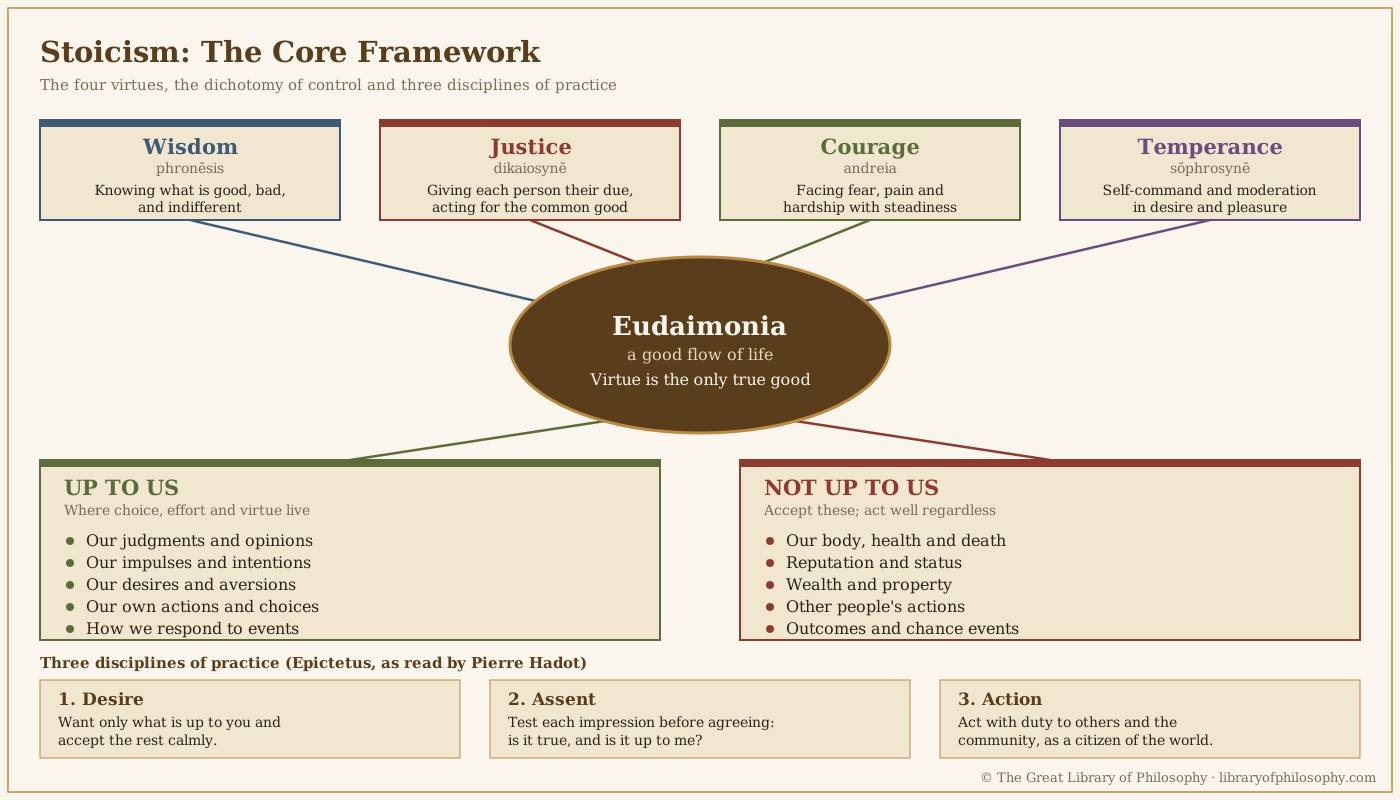
An overview of Stoic philosophy, connecting the four virtues, the dichotomy of control and the three disciplines.
How to Read the Map
The map moves from what the Stoics thought was good, to what we can and cannot control, to the practices that train judgement. Read it as a single argument: because virtue is the only genuine good, and because our own judgements are what we control, the Stoic task is to examine those judgements carefully.
The four cardinal virtues and eudaimonia
Stoic ethics holds that virtue is the only genuine good and that a flourishing life (eudaimonia) follows from living virtuously. The map names the four cardinal virtues: wisdom, courage, justice and temperance. The Stoics treated these as closely connected aspects of one rational character rather than as independent skills.
The dichotomy of control
The map separates what is "up to us", chiefly our judgements, intentions and choices, from what is not, such as health, reputation and other people's actions. This distinction is associated especially with Epictetus, whose Handbook opens with it. It directs effort toward one's own conduct rather than toward outcomes one cannot determine.
The three disciplines
The map also shows three disciplines: of desire (wanting only what is within one's power), of action (acting justly and with regard to others), and of assent (testing impressions before accepting them as true). Note that this three-part scheme is a modern reconstruction. It comes from Pierre Hadot's reading of Epictetus and Marcus Aurelius, not from an explicit list in the ancient sources, so it is best presented as an interpretive aid. The discipline of assent connects directly to Stoic epistemology, discussed under Epistemology in the main article.
Using the Map in Teaching
This Stoicism concept map can be used as a visual learning resource for introducing students to Hellenistic philosophy. It organises the major principles of Stoicism and shows how different philosophical ideas connect with one another. Rather than studying Stoic ethics, logic and physics as completely separate subjects, students can use the map to understand how these three areas form parts of a unified philosophical system.
The map is particularly useful for classroom discussions, revision and independent study. Students can follow the connections between fundamental Stoic doctrines, examine the reasoning behind them and use the visual structure to recall important concepts. Some questions it can support include:
- Why do the Stoics consider virtue the only true good, and what does this imply for health, wealth and external circumstances?
- How does the Stoic dichotomy of control differ from simply accepting everything that happens?
- What is the difference between receiving an impression and giving assent to it, and why is this distinction important in Stoic philosophy?
- How are Stoic ethics, logic and physics interconnected, and why did the Stoics consider all three necessary parts of philosophy?
- How does the Stoic understanding of nature and the rational structure of the universe influence its approach to ethical living?
For a fuller treatment, see the complete article on Stoicism or the Stoicism Study Guide (PDF), which includes a reading list and self-test questions. These resources can be used alongside the concept map to develop a more detailed understanding of Stoic philosophy.
Reuse and Citation
You may share and adapt this map for non-commercial and educational use, including in classes, handouts, blog posts and study groups, provided you give credit and link back to this page. This is offered under the Creative Commons Attribution 4.0 licence.
Suggested credit line
"Stoic Concept Map" by Kavya Jain, The Great Library of Philosophy, https://libraryofphilosophy.com/stoicism-concept-map.html
Suggested citation
Jain, Kavya. "Stoic Concept Map." The Great Library of Philosophy, 2026. https://libraryofphilosophy.com/stoicism-concept-map.html.
If you use the map in a course or publication, we would be glad to hear about it through the contact page.
Sources
-
Baltzly, D. "Stoicism." Stanford Encyclopedia of Philosophy. plato.stanford.edu/entries/stoicism
-
Epictetus. Discourses, Fragments, Handbook, trans. R. Hard. Oxford World's Classics, 2014.
-
Hadot, P. The Inner Citadel: The Meditations of Marcus Aurelius, trans. M. Chase. Harvard University Press, 1998.
-
Long, A. A., and D. N. Sedley. The Hellenistic Philosophers, 2 vols. Cambridge University Press, 1987.