Overview
What Is Deontology vs Utilitarianism?
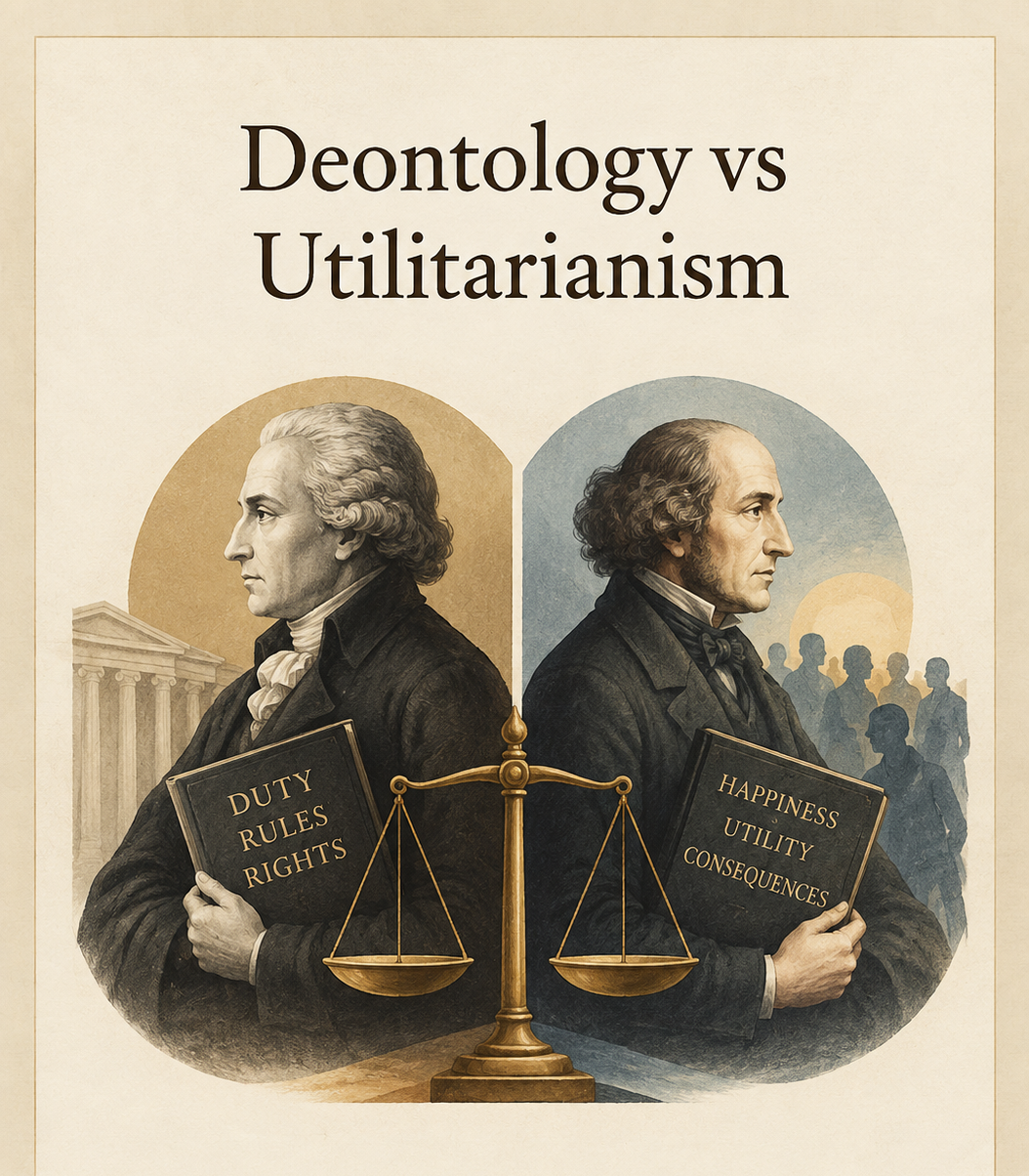
Deontology vs utilitarianism refers to a major
debate in normative ethics concerning what makes an action morally
right. Deontology gives a central role to duties, rules, rights,
and moral constraints, while utilitarianism gives a central role
to the consequences of action and their effect on the overall
well-being of everyone affected.
The distinction became especially important in modern European
moral philosophy. Immanuel Kant is the central
figure of modern deontological ethics, while
Jeremy Bentham and
John Stuart Mill are central figures in classical
utilitarianism. Their actual positions were more sophisticated
than a simple opposition between "rules" and "results."
In one sentence:
Deontology asks whether an action respects what morality requires,
while utilitarianism asks what the action brings about for
everyone affected; the distinction is especially important in
debates about rights, constraints, and the role of consequences.
Reference data
Deontology vs Utilitarianism: Quick Facts
- Field
- Ethics (normative ethics)
- Central question
- What makes an action morally right or wrong?
- Deontology
-
Gives duties, rules, rights, and constraints a central role in
moral evaluation
- Utilitarianism
-
Gives consequences and overall utility or well-being a central
role in moral evaluation
- Deontological thinkers
-
Kant and later rights-based and contractualist theorists
- Utilitarian thinkers
- Bentham, Mill, and later consequentialists
- Important concepts
-
Duty, categorical imperative, rights, consequences, utility,
consequentialism, act and rule utilitarianism
- Major period
-
Especially influential in eighteenth- and nineteenth-century
European moral philosophy, and central to ethics today
- Third reference point
-
Virtue ethics, which focuses on character rather than duties
or consequences
Deontology
What Is Deontology?
Deontology is a family of normative ethical
theories concerned with what people are morally required,
forbidden, or permitted to do. The word derives from the Greek
deon, meaning duty or obligation. Deontological theories
evaluate choices through concepts such as duty, rights, rules, and
moral constraints rather than treating consequences as the sole or
fundamental standard of rightness.
Immanuel Kant is the philosopher most closely
associated with modern deontological ethics. His
Categorical Imperative provides a framework for
testing the principles on which people act and for treating
rational persons with respect rather than merely as means to an
end. Kantian ethics is only one form of deontology, however; later
theories are built around rights, constraints, contractualist
reasoning, and different accounts of what agents owe one another.
The central deontological insight is that some moral
considerations can constrain what we may do even when violating
them would appear to produce a better outcome. This creates the
characteristic tension with consequentialist theories.
Deontology
A family of normative ethical theories that evaluate action
through duties, rules, rights, and moral constraints, rather
than treating the goodness of consequences as the fundamental
standard of right action.
Utilitarianism
What Is Utilitarianism?
Utilitarianism is a family of consequentialist
ethical theories that evaluate conduct in relation to overall
utility or well-being. In classical versions, pleasure, happiness,
and the absence of pain play a central role in determining what is
valuable. The basic idea is not that people should pursue only
their own happiness, but that moral reasoning should take the
interests of everyone affected into account.
Utilitarianism is a form of consequentialism, not
a synonym for it. Consequentialism is the broader family of
theories that make the goodness of consequences fundamental to
moral evaluation; utilitarianism adds a particular account of what
should be promoted, traditionally overall utility, happiness, or
welfare.
Jeremy Bentham and John Stuart Mill developed the classical
tradition in different ways. Later utilitarians revised the theory
in response to questions about measurement, rights, justice, and
the demandingness of maximizing overall well-being. Utilitarianism
is therefore best understood as a family of related theories
rather than a single doctrine.
Utilitarianism
A consequentialist approach to ethics that evaluates actions,
policies, or rules by their contribution to overall utility or
well-being, giving equal consideration to everyone affected.
Philosophical comparison
What Is the Difference Between Deontology and Utilitarianism?
The central difference concerns the basis of moral evaluation.
Deontology asks whether an action respects the relevant duty,
rule, right, or constraint. Utilitarianism asks whether the action
produces the best overall consequences according to the relevant
account of utility or well-being.
The contrast should not be reduced to the claim that deontologists
"never care about consequences" while utilitarians "never care
about rules." Deontological theories can recognize consequences as
morally relevant without making them the ultimate criterion, and
utilitarian reasoning can support stable rules when following them
tends to produce better outcomes. The more precise disagreement
concerns what ultimately makes an action right or wrong.
Deontology vs Utilitarianism: Core Differences
| Question |
Deontology |
Utilitarianism |
| Primary standard |
Duty, obligation, rights, rules, or moral constraints
|
Overall consequences and utility |
| Basic question |
"What am I morally required or forbidden to do?" |
"Which available action produces the best overall
outcome?"
|
| Consequences |
May matter, but are not the fundamental criterion of
rightness
|
Constitute the central basis of moral evaluation |
| Rights and constraints |
Can place limits on what may be done to people |
May be justified instrumentally by their effects on
well-being
|
| Intention |
Can have significant moral importance, especially in
Kantian ethics
|
Consequences of conduct are central to evaluation |
| Moral dilemmas |
May involve conflict between duties or constraints |
Compares expected consequences and overall utility |
| Representative thinkers |
Kant and later deontological theorists |
Bentham, Mill, and later utilitarians |
Key distinction:
Deontology asks whether an action respects what morality requires,
while utilitarianism asks what the action brings about for
everyone affected.
Conceptual map
How Do Duty and Consequences Shape Moral Judgment?
The deontology vs utilitarianism debate can be represented as a
question about two major routes through which philosophers reach a
moral judgment. The diagram below is a simplified conceptual map.
It does not mean that deontologists ignore consequences or that
utilitarians ignore rules.
Two Approaches to Moral Evaluation
Deontological emphasis
Duties, rights, and moral constraints determine what may or
may not be done, even when a different action would produce
better outcomes.
Duty
→
Constraint
→
Action
→
Moral judgment
Utilitarian emphasis
The consequences of each available option for everyone
affected determine which action is morally best.
Options
→
Consequences
→
Utility
→
Moral judgment
Important:
These are tendencies rather than absolute divisions.
Deontologists can treat outcomes as morally relevant, and
utilitarians can defend rules and rights because of their
consequences.
Third approach
How Does Virtue Ethics Compare With Deontology and Utilitarianism?
Deontology and utilitarianism are often presented alongside
virtue ethics because the three approaches
organize moral reasoning around different central questions.
Deontology emphasizes duties and rules; utilitarianism emphasizes
consequences and overall welfare; virtue ethics focuses on
character, virtues, practical wisdom, and the kind of person one
should become.
Three Major Approaches in Normative Ethics
| Ethical theory |
Central question |
Main focus |
Key figure |
| Deontology |
What is my moral duty? |
Duties, rules, rights, obligations, constraints |
Immanuel Kant |
| Utilitarianism |
Which action produces the best overall consequences?
|
Utility, happiness, welfare, consequences |
Bentham / Mill |
| Virtue ethics |
What would a virtuous person do? |
Character, virtues, practical wisdom, flourishing |
Aristotle |
These theories can sometimes reach the same practical conclusion
for different reasons. Helping a person in need may be supported
by a deontological duty, by a utilitarian calculation of improved
well-being, or by the virtue of compassion. Their disagreement is
therefore not always about the final action; it can concern the
philosophical reason that makes the action right.
Major thinkers
Who Developed Deontology and Utilitarianism?
The deontological and utilitarian traditions developed through
several philosophers whose theories differ substantially. The
labels are useful for understanding broad historical patterns, but
individual thinkers should not be reduced to a single doctrine.
Immanuel Kant
Kant (1724–1804) is the central modern philosopher of
deontological ethics. He grounds obligation in rational
principles and develops the Categorical Imperative as a test
of moral maxims, emphasizing universalizability and respect
for humanity as an end in itself.
Jeremy Bentham
Bentham (1748–1832) developed the first systematic modern
account of utilitarianism, treating utility as a standard for
judging conduct, laws, and institutions by their tendency to
promote happiness and reduce suffering.
John Stuart Mill
Mill (1806–1873) inherited Bentham's tradition but
distinguished higher and lower qualities of pleasure and
connected utilitarianism with liberty, justice, education, and
human development.
Later Deontologists
Contemporary deontology includes theories built around rights,
agent-relative constraints, duties, and contractualist
reasoning. Deontology is broader than Kantian ethics.
Later Utilitarians
Later utilitarians and consequentialists developed rule-based
and other refined forms of the theory, and new accounts of
value, welfare, and decision-making under uncertainty.
Aristotle
Aristotle's virtue ethics, focused on character and human
flourishing, is often treated as the third major reference
point when comparing normative ethical theories.
Historical development
How Did Deontology and Utilitarianism Develop?
Neither theory is the invention of a single philosopher. Earlier
thinkers contributed ideas that later became important to both
utilitarianism and theories of moral obligation. The modern forms
of the two traditions took shape during the eighteenth and
nineteenth centuries, when philosophers were reconsidering the
foundations of morality, law, politics, and human motivation.
Ancient foundations
Virtue, justice, and the good life
Ancient Greek philosophy develops influential accounts of
virtue, justice, happiness, and the good life. Aristotle's
virtue ethics later becomes a third reference point for
comparing normative theories.
17th–18th centuries
New accounts of moral obligation
Early modern philosophers develop new accounts of moral
obligation, rationality, motivation, rights, and political
order, creating the intellectual environment in which Kantian
ethics and modern utilitarianism emerge.
1785
Kant's Groundwork
Kant publishes
Groundwork of the Metaphysics of Morals, presenting
central arguments concerning moral duty, good will, universal
law, and the Categorical Imperative.
1789
Bentham and the principle of utility
Bentham's
Introduction to the Principles of Morals and
Legislation
presents a systematic utilitarian theory and applies it to
morality, law, punishment, and social reform.
1861
Mill's Utilitarianism
Mill develops and defends the utilitarian tradition in
Utilitarianism, distinguishing higher and lower
pleasures and linking the theory to liberty and justice.
20th–21st centuries
Diverse families of theories
Both traditions develop into diverse families of theories.
Contemporary deontology explores rights, constraints, and
contractualism, while consequentialist theories develop new
accounts of value, rules, welfare, and decision-making.
Method
How Do Deontology and Utilitarianism Reason About Moral Problems?
The difference becomes clearest when the same situation is
described in two different moral vocabularies. A deontologist
begins by asking what duties or constraints apply. A utilitarian
begins by asking which available choice is expected to produce the
best overall consequences.
Deontological reasoning
Identify the proposed action and the principle behind it; ask
what duties, rights, or constraints apply; consider whether
the principle can be morally justified; and determine whether
acting would respect the relevant requirement.
Utilitarian reasoning
Identify the available actions; consider the likely
consequences of each; assess the benefits and harms for
everyone involved; and select the option expected to produce
the best overall result.
If an action violates a strong moral constraint but appears likely
to produce a large net benefit, the two analyses may pull in
different directions. This is why difficult cases can produce
opposing judgments.
Examples
What Are Some Real-Life Examples of Deontology and Utilitarianism?
Deontology examples and
utilitarianism examples help make the contrast
concrete. The cases below are simplified illustrations of the
kinds of reasons each theory can emphasize, not complete solutions
to complex real-world problems.
1. Keeping or breaking a promise
Deontological reasoning may emphasize the duty of promise
keeping. Utilitarian reasoning asks which option produces
greater overall well-being, including wider effects on trust.
2. Lying to prevent harm
A deontological analysis focuses on whether lying violates a
moral duty. A utilitarian analysis asks whether telling the
truth or the lie is expected to produce better consequences.
3. Sacrificing one to help several
A deontological theory may impose a constraint against using a
person merely as a means. A utilitarian analysis evaluates the
consequences for all affected people.
4. Allocating scarce medical resources
Utilitarian reasoning may weigh expected health benefits.
Deontological reasoning may stress equal respect, rights, and
duties to individual patients.
Thought experiment
The Trolley Problem: Deontology vs Utilitarianism
The trolley problem is one of the best-known
thought experiments for examining the relationship between moral
rules, consequences, intention, and the permissibility of harming
individuals. In a basic version, a runaway trolley threatens
several people, while diverting it would save them at the cost of
harming one person on another track.
A straightforward utilitarian approach focuses on
consequences: if diverting the trolley is expected to result in
fewer deaths or greater overall well-being, that provides a strong
reason to act. A deontological approach asks
additional questions about what the agent is doing to the person,
what duties or constraints apply, and whether the individual is
being treated merely as a means.
Important caution:
The trolley problem does not prove that "utilitarians pull the
lever" while "deontologists never do." Different versions of the
case change its moral structure, and philosophers within both
traditions disagree about how the details should be analyzed.
Within utilitarianism
What Are Act Utilitarianism and Rule Utilitarianism?
Act utilitarianism evaluates a particular action
by its expected consequences. Rule utilitarianism
instead evaluates rules by considering the consequences of
generally accepting or following them, and then uses justified
rules to guide conduct.
This distinction matters for comparisons with deontology because
rule utilitarianism can look superficially similar to a duty-based
theory: both can tell people to follow rules in ordinary
situations. The justification remains different. A utilitarian
rule is justified by its consequences, whereas a deontological
duty is not ultimately justified merely by the aggregate
consequences of following it. Rule utilitarianism therefore
remains consequentialist and should not simply be classified as
deontology.
Act utilitarianism
Asks which particular action will produce the best
consequences in the situation at hand.
Rule utilitarianism
Asks which rules would produce the best consequences if
generally followed, and then treats those rules as guides to
action.
Evaluation
What Are the Strengths and Criticisms of Deontology?
Deontological ethics has enduring appeal because it captures the
intuition that some actions should not be justified simply by
pointing to desirable outcomes. It gives a strong philosophical
foundation for ideas such as rights, dignity, consent, and limits
on what may be done to individuals.
Strengths
- Protects moral constraints and individual rights.
-
Resists treating people merely as instruments for aggregate
benefit.
-
Provides a clear role for duties, obligations, and
prohibitions.
-
Explains why some actions seem wrong even when they have
attractive outcomes.
- Emphasizes respect for persons and moral consistency.
Common criticisms
- Conflicting duties can create difficult cases.
-
Strict rules can appear insensitive to unusual consequences.
-
Some formulations face questions about exceptions and
trade-offs.
-
It can be hard to decide which duties take priority when
they conflict.
-
Different deontological theories disagree about the source
and scope of constraints.
Evaluation
What Are the Strengths and Criticisms of Utilitarianism?
Utilitarianism has a powerful practical attraction because it
takes the effects of action seriously and asks moral agents to
consider everyone affected. This makes the theory especially
compelling in questions of public policy, resource allocation,
harm prevention, and social welfare.
Strengths
-
Places strong emphasis on reducing suffering and promoting
well-being.
-
Treats the interests of affected people impartially in
classical formulations.
-
Provides a standard that can be applied to policies and
institutions.
-
Encourages attention to real-world effects rather than
intentions alone.
-
Explains why preventing large amounts of harm can carry
great moral weight.
Common criticisms
-
It is difficult to measure and compare different forms of
well-being.
- Expected consequences are often uncertain.
-
Critics question whether maximizing aggregate welfare
adequately protects individual rights.
-
Demanding versions can appear to require extensive personal
sacrifice.
-
Disagreement about the nature of utility produces different
versions of the theory.
Shared ground
What Do Deontology and Utilitarianism Have in Common?
Despite their famous disagreement, the two theories share several
important features. Both are
normative ethical theories that try to give
reasons about how people ought to act rather than merely
describing how they actually behave, and both offer structured
methods of moral reasoning rather than personal preference.
Both are normative
Both aim to explain what people ought to do and why an action
is required, permitted, or forbidden.
Both use structured reasoning
Deontology examines duties and principles; utilitarianism
examines consequences and utility. Neither is mere opinion.
Both can agree in practice
Keeping promises, helping those in need, and respecting
autonomy can be supported by both, even when the explanation
differs.
Both have internal diversity
Neither deontology nor utilitarianism represents one
completely uniform philosophical position.
Clarification
Common Misconceptions About Deontology and Utilitarianism
The deontology vs utilitarianism distinction is useful, but
simplified descriptions can create misleading impressions.
"Deontologists ignore consequences."
This is too strong. Deontological theories can treat
consequences as morally relevant without making them the
fundamental standard of rightness.
"Utilitarians reject rules."
This is also misleading. Utilitarians can defend stable rules
and rights when following them tends to produce better
consequences.
"Deontology means Kantian ethics."
Kant is central, but deontology is a broader family that
includes rights-based, constraint-based, and contractualist
theories.
"Rule utilitarianism is deontology."
Rule utilitarianism remains consequentialist because its rules
are justified by the consequences of following them.
Contemporary relevance
How Do Deontology and Utilitarianism Apply to Modern Ethical
Problems?
The comparison remains useful beyond classroom thought
experiments. Modern ethical questions often involve competing
concerns about outcomes, rights, duties, risk, fairness, and
institutional responsibility, and the two theories provide
different conceptual tools for organizing them.
Business ethics
Utilitarian reasoning weighs overall benefits and harms for
everyone affected. Deontological reasoning emphasizes honesty,
informed consent, non-deception, and contractual duties.
Medical ethics
Utilitarian approaches emphasize aggregate health outcomes;
deontological approaches emphasize consent, confidentiality,
and duties to individual patients. Actual practice combines
several principles.
Artificial intelligence
Consequentialist reasoning focuses on expected benefits,
harms, and social effects; deontological reasoning on rights,
privacy, consent, fairness, and dignity.
Quick answers
Frequently Asked Questions About Deontology vs Utilitarianism
What is deontology?
Deontology is a family of normative ethical theories that
evaluate action through duties, rules, rights, and moral
constraints rather than treating the consequences of an action
as the sole or fundamental standard of its rightness.
What is utilitarianism?
Utilitarianism is a family of consequentialist ethical
theories that evaluate action by its consequences for overall
utility or well-being, taking into account the interests of
everyone affected.
What is the difference between deontology and utilitarianism?
Deontology evaluates moral action primarily through duties,
rules, rights, or constraints, while utilitarianism evaluates
action by its consequences for overall utility or well-being.
A deontological approach can hold that some actions are wrong
even when they would produce better outcomes; utilitarian
reasoning makes the quality of outcomes central.
Is Kant a deontologist?
Yes. Immanuel Kant is the philosopher most closely associated
with modern deontological ethics. His moral philosophy grounds
obligation in rational principles and the Categorical
Imperative rather than making the goodness of consequences the
fundamental basis of right action.
Is utilitarianism a form of consequentialism?
Yes. Utilitarianism is the best-known family of
consequentialist moral theories. It evaluates conduct
according to consequences and identifies the relevant good in
terms of overall utility, welfare, happiness, or related
accounts of value.
Who developed utilitarianism?
Jeremy Bentham developed the first systematic modern account
of utilitarianism, while John Stuart Mill later revised and
defended the tradition, including his distinction between
higher and lower pleasures.
What is an example of deontology?
Keeping a promise because one regards promise-keeping as a
moral duty illustrates deontological reasoning. The central
question is whether the action respects the relevant moral
obligation rather than whether breaking the promise would
happen to produce better consequences.
What is an example of utilitarianism?
Choosing the policy expected to produce the greatest overall
improvement in well-being illustrates utilitarian reasoning.
The assessment focuses on the consequences for everyone
affected rather than on whether an action follows an absolute
rule.
How does virtue ethics differ from deontology and
utilitarianism?
Virtue ethics focuses primarily on character and the virtues
of a good person. Deontology emphasizes duties, rules, or
moral constraints, while utilitarianism evaluates consequences
and overall utility. These approaches can sometimes recommend
the same action while giving different reasons for it.
What is the trolley problem in deontology and utilitarianism?
The trolley problem asks how a person should respond when
different choices appear to involve different numbers or kinds
of harms. Utilitarian reasoning focuses strongly on the
consequences, while deontological reasoning examines duties,
constraints, intention, and whether individuals are being
treated permissibly.
Are deontology and utilitarianism complete opposites?
No. The contrast is useful for understanding normative ethics,
but the two approaches are not complete opposites.
Deontologists can recognize that consequences matter, and
utilitarians can recognize the practical value of rules.
References
Sources and Further Reading
The following scholarly references provide background for the
definitions, historical framing, and theoretical distinctions used
on this page.
Conclusion
Why Is the Deontology vs Utilitarianism Debate Important?
The deontology vs utilitarianism debate is important because it
addresses one of the central questions of ethics: what makes an
action morally right or wrong.
Deontological philosophers emphasize duties, rights, and
constraints that limit what may be done, while utilitarian
philosophers emphasize the consequences of action for the
well-being of everyone affected.
The distinction became particularly influential in modern moral
philosophy through thinkers such as Kant, Bentham, and Mill. Their
disagreements extend beyond the simple question of duty versus
consequences to deeper problems involving rights, justice,
intention, impartiality, uncertainty, and the limits of moral
demand.
The continuing importance of the debate lies in the questions it
raises for medicine, business, law, public policy, and emerging
technologies: how much weight outcomes should carry, and whether
some things must never be done to persons regardless of the
benefits.
Final takeaway:
Deontology and utilitarianism should not be understood simply as
"rules versus results." They represent different philosophical
emphases within a larger investigation of what makes actions right
or wrong, what we owe to one another, and how moral reasoning
should proceed.