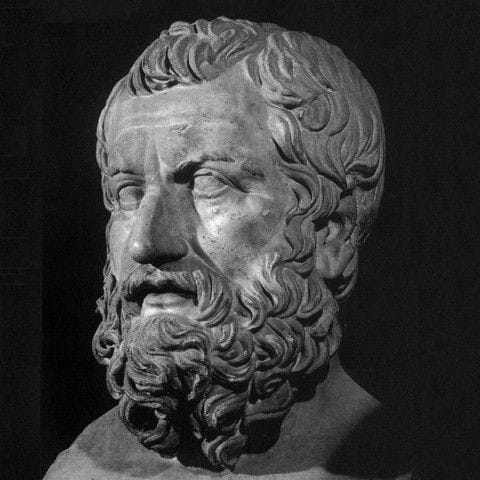
The Question That Made Thales Important
Sometime in the sixth century BCE, in the prosperous Ionian city of Miletus on the coast of Asia Minor, a thinker named Thales became associated with a question that would echo through the history of philosophy: What is the world ultimately made of? We cannot reconstruct exactly how Thales himself formulated the question, because no complete work written by him survives. Much of the surviving evidence comes through later ancient writers who preserved traditions about his ideas, investigations, and reputation.
What makes Thales important, therefore, is not simply a list of doctrines attributed to him. His historical significance lies partly in the kind of explanation he came to represent. The tradition associates him with the attempt to identify an underlying principle within nature itself rather than explaining the structure of the cosmos only through stories about divine beings. That approach became an important starting point for the tradition now called Ancient Greek philosophy.
Thales is traditionally associated with the claim that water was the fundamental principle, or archê, of nature. To a modern reader, this can sound like a primitive scientific hypothesis. It was certainly not a correct account of physical reality in the modern scientific sense. Yet judging the proposal only by whether water really is the fundamental substance misses the philosophical development involved: the attempt to explain enormous diversity by searching for something fundamental beneath it.
That question would outlive Thales by more than two thousand years. Philosophers would continue to ask whether reality has a single underlying substance, whether everything is ultimately material, whether change is fundamental, and whether the world possesses an intelligible order. In that sense, the question associated with Thales leads directly toward metaphysics: the investigation of being, reality, substance, causation, and what ultimately exists.
Why Miletus Mattered
Thales did not emerge from an intellectual vacuum. Miletus was one of the major cities of ancient Ionia, a region on the western coast of Asia Minor that was deeply connected to Mediterranean trade. Merchants, sailors, travelers, and other specialists moved through the region, bringing different customs, practical knowledge, astronomical observations, and accounts of the natural world into contact with one another.
Historical circumstances never explain philosophy by themselves, but they can help us understand the environment in which new questions become possible. The Greeks already possessed rich traditions of poetry and mythology. Homer and Hesiod offered accounts of gods, origins, conflict, order, and the structure of the cosmos. These traditions were not merely failed science; they were cultural frameworks for interpreting human life and the world.
The Milesian project is distinctive because its surviving descriptions point toward another kind of explanatory ambition. The question becomes not only which divine power is responsible for a phenomenon, but what principle could explain phenomena as parts of an intelligible natural order. This should not be exaggerated into a clean rejection of religion. Sixth-century BCE categories were not identical to modern divisions between religion, philosophy, and science.
What changed was the style of explanation. Nature became something that could be investigated, compared, interpreted, and argued about. Once a proposed principle could be discussed as a claim about the world, another thinker could challenge it and offer a rival account. That argumentative openness is one reason the early Milesians matter so much in the history of philosophy.
Beyond the Simple “Myth to Reason” Story
It is tempting to describe the birth of Greek philosophy as a simple movement from myth to reason: people supposedly stopped believing in gods and suddenly began doing science. That story is too neat. The early Greek philosophers lived within religious cultures, and the evidence does not justify treating mythology and philosophy as two completely separate worlds.
A better way to understand the development is methodological. Philosophical explanations became claims that could be questioned, challenged, compared, and developed into arguments. The issue was not simply whether a thinker used the word “god,” but whether an account attempted to explain natural phenomena through an intelligible order that could itself become the subject of inquiry.
The Milesians illustrate this process especially well. Thales was associated with water. Anaximander, traditionally placed after him, proposed the more abstract apeiron, commonly translated as the Boundless, Unlimited, or Indefinite. Anaximenes then returned to a determinate physical principle, identifying air as fundamental and connecting transformation with processes such as rarefaction and condensation.
The disagreements matter as much as the answers. Philosophy does not progress only when someone discovers the final correct theory. It also progresses when one explanation creates a problem that another thinker tries to solve. Thales’ proposal can therefore be understood as the beginning of a conversation rather than the final answer to a cosmological question.
Why Water Was the Archê
The claim that water was the fundamental principle of nature is one of the most famous ideas associated with Thales. Yet an important historical limitation should remain visible: no complete philosophical treatise by Thales survives. Aristotle is a major source for the report that Thales identified water as the nature or originating principle of things, and later traditions add other details.
The Greek word archê can mean beginning, origin, source, or governing principle. In the context of early Greek natural philosophy, it does not map neatly onto a modern scientific term such as “element” or “particle.” The question is broader: what fundamental principle could account for the existence and transformation of the natural world?
Why water? Ancient evidence does not allow us to reconstruct Thales’ exact reasoning with certainty. Aristotle speculated that observations about nourishment, moisture, and the generation of living things may have helped motivate the claim. Later reconstructions have also emphasized the importance of water to agriculture, rivers, growth, and the natural environment. These are possible explanations, not secure quotations from Thales’ own argument.
The philosophical significance is therefore broader than the literal proposition that everything is made of water. Thales became associated with the search for unity beneath multiplicity. The world contains trees, animals, stones, clouds, rivers, stars, and human beings, yet the philosophical question asks whether this diversity can ultimately be understood through something more basic.
Later philosophers transformed the question in very different directions. Parmenides challenged ordinary assumptions about change and Being; Plato distinguished the sensible world from intelligible Forms; Aristotle developed accounts of substance, matter, form, actuality, and causation. Their systems are far more sophisticated than the theory attributed to Thales, but they continue to wrestle with the problem of what reality is fundamentally like.
Thales and the Famous Eclipse
Thales is also remembered for his interest in astronomy. Herodotus reports that Thales predicted a solar eclipse during the conflict between the Medes and Lydians, traditionally identified with the eclipse of 28 May 585 BCE. The story became one of the most famous episodes in the later image of Thales as an unusually wise natural investigator.
The historical situation is more complicated than the popular story suggests. The eclipse itself can be dated astronomically, but we do not possess a surviving account from Thales explaining how he supposedly predicted it. Later writers also transmitted the story through traditions that were themselves removed from the event. The method of prediction therefore remains uncertain.
That uncertainty matters because it prevents us from turning the episode into a simple claim that Thales possessed modern astronomical knowledge. Some later commentators have proposed connections with Babylonian astronomical records or eclipse cycles, but there is no secure evidence establishing the exact method he used.
What the story does reveal is how ancient writers understood the significance of Thales. He was remembered as someone who tried to understand striking celestial events through patterns in nature rather than treating them solely as supernatural interventions. The eclipse became a symbol of the broader intellectual shift associated with the Milesian tradition.
Thales, Mathematics, and Abstraction
Ancient traditions also associate Thales with mathematics and geometry. Later sources credit him with several geometric results, and he is sometimes described as having brought mathematical knowledge from Egypt into Greece. These claims are difficult to disentangle from later mathematical tradition, so they should be treated with the same caution required by the stories about his astronomy.
Nevertheless, the mathematical tradition surrounding Thales is philosophically interesting. Geometry turns particular measurements into abstract relationships. A specific triangle or distance becomes an instance of a general relationship that can be reasoned about independently of the individual physical object.
This movement from observation toward abstraction belongs to the larger intellectual environment of early Greek thought. Practical knowledge of measurement and astronomy could become connected with theoretical questions about why particular relationships hold. Philosophy and mathematics were therefore not initially separated into the sharply defined disciplines familiar today.
Thales, Anaximander, and Anaximenes
Thales’ importance becomes clearer when he is placed beside the two thinkers traditionally associated with the Milesian school: Anaximander and Anaximenes. The ancient tradition presents them as closely connected, although the details of their teacher-pupil relationships are not all historically secure. What unites them more securely is their engagement with questions about the nature and transformation of the cosmos.
Anaximander moved beyond the identification of the ultimate principle with a familiar substance by proposing the apeiron, an indefinite or boundless principle. His proposal makes the original problem more abstract: perhaps the source of reality cannot simply be one of the visible things found within the world.
Anaximenes, by contrast, associated the fundamental principle with air and attempted to explain differences in matter through processes of condensation and rarefaction. His theory addresses a problem that appears almost immediately once one posits a single underlying principle: if one thing is fundamental, how can it generate the extraordinary variety of things we experience?
Seen together, the Milesians show philosophy functioning as an intergenerational argument. A question is proposed, an answer is given, the answer generates new difficulties, and another thinker attempts to improve the explanation. The history of philosophy is full of this pattern.
Thales’ enduring importance may therefore lie less in the finality of his answer than in the fact that his proposed answer could become the starting point for disagreement. Once an explanation can be challenged, philosophy has room to develop.
Was Thales Really the First Philosopher?
Thales is often called the “first philosopher,” but the phrase needs careful qualification. It does not mean that Thales was the first human being to ask philosophical questions. Long before sixth-century BCE Greece, intellectual traditions in India, Egypt, Mesopotamia, China, and elsewhere reflected on existence, morality, order, knowledge, death, and the cosmos.
The title is better understood as a statement about the history of Western philosophy. Aristotle placed Thales at the beginning of a Greek investigation into principles and causes of the natural world, and later histories inherited that framing. Within that tradition, Thales occupies a traditional starting point for the Pre-Socratic investigation of nature.
Even here, the boundary is not absolute. Greek philosophy did not suddenly appear fully formed with Thales, nor did it develop in isolation from the wider ancient Mediterranean and Near Eastern world. Trade, travel, mathematics, astronomy, religion, and cultural exchange formed part of the environment in which early Greek thought developed.
So it is more accurate to say that Thales occupies a traditional starting point in the history of Greek philosophy than to claim that he invented philosophy itself. That distinction recognizes both the importance of the Milesian project and the much broader history of human reflection.
How Thales Helped Create a Metaphysical Problem
The moment a philosopher asks what is fundamentally real, the discussion begins moving toward metaphysics. Thales’ search for an archê therefore has a remarkably long afterlife. Later philosophers would disagree about whether reality is fundamentally material, immaterial, changing, unchanging, unified, plural, or structured by principles that cannot be reduced to physical substances.
Heraclitus would emphasize becoming and change. Parmenides would argue that genuine Being cannot undergo the kind of change ordinary experience seems to reveal. Plato would distinguish changing sensible things from intelligible Forms, while Aristotle would develop a systematic account of substance, matter, form, actuality, potentiality, and causes.
These later theories are vastly more elaborate than the cosmological proposal associated with Thales. Yet they continue to circle around questions already visible in the Milesian project: What is ultimately real? What explains change? What makes the world intelligible? Can the many things we experience be understood through something more fundamental?
This is why Thales belongs not merely to the history of astronomy or early science but to the history of metaphysics. His importance lies partly in helping establish a question that philosophy would spend centuries making more precise.
Thales’ Real Intellectual Legacy
It is easy to remember Thales simply as the man who said that everything came from water. But that interpretation makes his historical importance look smaller than it is. His proposed principle was eventually challenged and replaced. The more enduring legacy is the attempt to search for an intelligible account of nature rather than treating inherited explanations as beyond question.
That does not mean Thales possessed the modern scientific method. He did not have modern laboratories, experimental instruments, mathematical physics, or the accumulated body of scientific knowledge available today. Calling him a modern scientist would therefore be misleading. What he represents is something earlier and more basic: the willingness to ask whether nature can be understood through discoverable principles.
Once an explanation is treated as something that can be examined rather than simply inherited, disagreement becomes productive. Another thinker can propose a different explanation. The two can be compared. Arguments can be developed. Weaknesses can be exposed. Questions can become more precise.
That is one reason philosophy remains alive. Philosophical progress does not always mean accumulating correct answers in a straight line. Sometimes it means learning how to ask a better question.
What Thales Can Teach Us Today
We no longer need to explain eclipses, storms, or earthquakes in the same way that people in the ancient world did. Modern science provides powerful mathematical and empirical frameworks for understanding natural phenomena. Yet the intellectual habit associated with Thales has not become obsolete.
We still inherit explanations from families, cultures, institutions, political communities, schools, and social environments. Some are reliable. Some are incomplete. Some are simply familiar. The difficult intellectual task is learning to distinguish familiarity from evidence.
The philosophical attitude associated with Thales encourages a different question: instead of asking only, “What have I been told?”, ask, “What is the reason for believing this?” Instead of accepting an explanation because it is traditional, ask what supports it. And instead of replacing one unquestioned belief with another, remain willing to revise a position when stronger reasons appear.
The point is not that every old idea is wrong or that every new idea is better. Tradition can preserve genuine wisdom, while novelty can produce serious errors. The philosophical attitude is more demanding: neither tradition nor novelty should receive intellectual authority merely because of where it comes from.
In that sense, the question associated with Thales remains surprisingly modern: Is there a better explanation?
Why Thales Still Matters
Thales of Miletus did not leave behind a philosophical system comparable to Plato or Aristotle. We do not possess a complete book written in his own hand, and many details of his life and thought remain uncertain. Much of his reputation comes through later ancient testimony, which means that studying Thales also requires studying how later philosophers remembered him.
Yet uncertainty does not make him unimportant. Thales stands near the beginning of a tradition in which thinkers increasingly treated questions about nature, reality, and explanation as problems that could be investigated through reasoned inquiry. His answer—water—was only one answer among many. The question it represents proved much harder to exhaust.
Anaximander proposed the apeiron. Anaximenes proposed air. Heraclitus emphasized change. Parmenides challenged the possibility of genuine change. Plato and Aristotle transformed the philosophical landscape. Across these disagreements, the basic activity remained recognizable: propose an account, examine its consequences, discover its difficulties, and ask whether a better explanation is possible.
What survives from Thales, then, is not a scientific theory that we should accept today. It is an intellectual posture. The world is not merely something to inherit stories about; it is something to investigate. Explanations are not sacred merely because they are old. And a question can be more historically important than the first answer given to it.
Thales still matters because philosophy begins again whenever someone looks at an accepted explanation and asks whether there is a better one.
Frequently Asked Questions
Was Thales really the first philosopher?
Thales is traditionally called the first philosopher in the history of Western philosophy because Aristotle and later traditions placed him near the beginning of the Greek investigation of nature and first principles. The title does not mean that he was the first human being to ask philosophical questions.
What did Thales believe about water?
Thales is reported by Aristotle to have identified water as the archê, or originating principle, of nature. Because no complete work by Thales survives, the precise reasoning behind the claim cannot be reconstructed with certainty.
What does archê mean in Presocratic philosophy?
Archê can mean beginning, origin, source, or governing principle. In discussions of the Milesians, it refers to the fundamental principle or source used to explain the natural world and its transformations.
Did Thales really predict the solar eclipse of 585 BCE?
Ancient sources, especially Herodotus, report that Thales predicted the eclipse associated with the battle between the Medes and Lydians. The eclipse itself occurred in 585 BCE, but the method by which Thales may have predicted it remains uncertain.
What was the Milesian school?
The Milesian school is the modern name commonly given to the early natural philosophers associated with Miletus: Thales, Anaximander, and Anaximenes. They are grouped together because they investigated the nature and transformation of the cosmos through accounts centered on underlying principles within nature.
Why does Thales matter to metaphysics?
Thales matters to metaphysics because the question associated with his search for an archê asks what reality is fundamentally like and what can explain the diversity and change found in the world. Later philosophers transformed those questions into elaborate theories of being, substance, causation, and reality.
Further Reading
For readers who want to investigate the historical evidence and scholarly debates behind this article: