The Strange Fact About Socrates
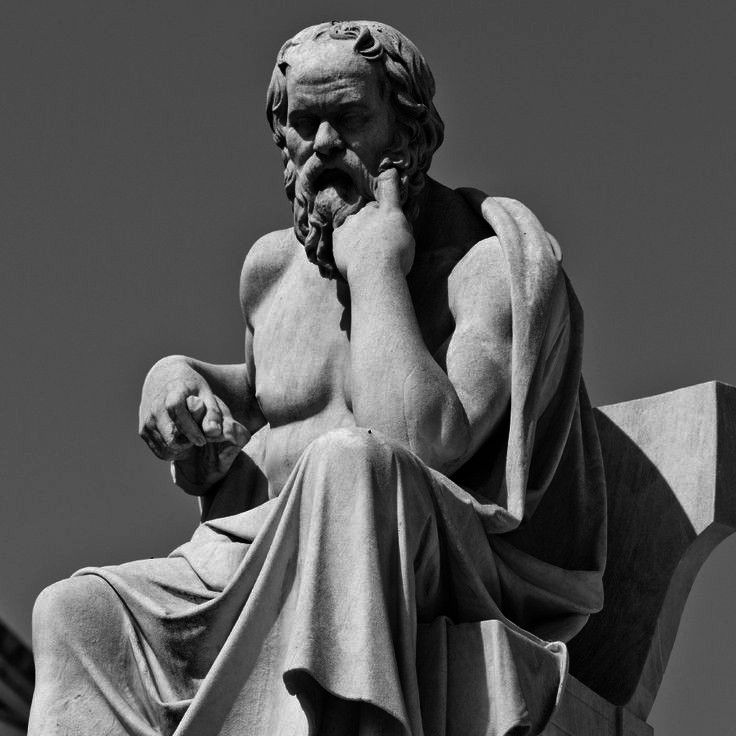
Start with the simplest fact. Socrates wrote nothing that survives, and ancient sources do not preserve a work that can confidently be identified as something he himself composed. What we have instead are portrayals: Plato makes Socrates the central speaker in many dialogues, Xenophon gives a different account of him, and Aristophanes turns a comic version of Socrates into a character in The Clouds .
That means the question “What did Socrates believe?” is already more complicated than it sounds. Before asking what his philosophy was, we have to ask how much of the philosophy attributed to him actually belongs to the historical man. Scholars call this difficulty the Socratic Problem . There is no universally accepted method that lets us simply separate “the real Socrates” from every literary and philosophical portrayal.
But the absence of Socrates' own writings is not just a historical inconvenience. It fits remarkably well with the picture of philosophy that emerges from the Platonic dialogues: philosophy is something people do together . It happens through questions, objections, revisions, hesitation, embarrassment, discovery, and sometimes aporia—the recognition that you do not yet know what you thought you knew.
“If philosophy is a conversation rather than a package of conclusions, then writing down the conclusion may preserve the words while losing the activity that produced them.”
Why Socrates Needed Conversation
The Socratic method is usually associated with relentless questioning. In many Platonic dialogues, Socrates asks an interlocutor what courage, justice, piety, virtue, or another concept actually is. The answer is then tested against further questions. If the definition creates a contradiction, the conversation starts again.
This is often called the elenchus , or elenctic examination. Its important feature is not simply that Socrates asks lots of questions. It is that the questions are responsive. What Socrates asks next depends on what the other person has just said. A contradiction discovered in one answer changes the direction of the next question.
That makes the method fundamentally interactive. A finished essay can present an argument, but it cannot react to the particular misunderstanding of a particular reader. A conversation can. The speaker can slow down, give an example, challenge an assumption, ask a new question, or abandon a line of argument when it proves unproductive.
This helps explain why Plato's dialogues matter so much. Even when a dialogue ends without a final answer, the movement of the discussion is philosophically significant. The reader is not simply handed a doctrine. The reader watches claims being tested.
The Argument Against Writing in the Phaedrus
The strongest ancient discussion of Socrates and writing appears in Plato's Phaedrus . Near the end of the dialogue, Socrates tells a story about Theuth, who presents writing to the Egyptian king Thamus as a useful invention. The story turns into a criticism of what writing does to memory and understanding.
The criticism is sharper than “books are bad.” The problem is what happens when people treat written words as a substitute for understanding. A person may possess information externally without having developed the ability to reason through it internally. Writing can therefore make someone appear knowledgeable without guaranteeing that genuine knowledge has been acquired.
Socrates then gives a second criticism. A written speech cannot answer its reader. If someone misunderstands it, the text cannot decide what the misunderstanding is or reshape its explanation accordingly. It repeats the same words. It travels to readers for whom it may not have been intended, including readers who lack the background needed to interpret it responsibly.
Plato's point is especially striking because the Phaedrus itself is a written work. The dialogue therefore does not simply say “never write.” Instead, it creates a philosophical tension: if writing is limited, what kind of writing can still encourage the reader to think rather than merely memorize?
Memory, Knowledge, and the Appearance of Wisdom
The first criticism in the Phaedrus concerns memory. The story of Theuth and Thamus presents writing as something that can produce reliance on external reminders. Instead of cultivating memory through repeated intellectual engagement, people may come to depend on marks outside themselves.
That distinction matters because Socratic philosophy is deeply suspicious of the difference between having an answer and understanding an answer . Someone can repeat a definition without being able to explain it. They can quote a rule without seeing where it applies. They can possess information while remaining unable to defend or examine it.
Seen this way, the target is not writing alone. The deeper target is passive possession of information. Writing becomes dangerous when the existence of a sentence on a page creates the illusion that the reader has mastered what the sentence says.
Why a Written Text Cannot Defend Itself
Imagine asking a book a question about one of its claims. The book cannot notice that you have misunderstood a key term. It cannot ask what you mean by your objection. It cannot change its explanation because you are confused. It can only give you the words that were written.
That is the deeper rhetorical problem Plato puts into Socrates' mouth. A written discourse becomes independent of its author. Once released, it can be copied, quoted, misunderstood, attacked, defended, or used in an argument that the original writer never imagined.
A live philosophical conversation is different. The speaker can diagnose the listener. The listener can challenge the speaker. Both sides can discover that a seemingly simple concept is more complicated than they expected. For Socrates, this responsiveness is not merely good teaching technique. It is part of philosophical inquiry itself.
That is why the Socratic dialogue is such a clever literary form. Plato gives the reader a written object that behaves, at least to some degree, like a conversation. The reader encounters questions, answers, objections, reversals, and moments of uncertainty rather than a straightforward philosophical textbook.
The Socratic Problem: We Know Him Through Other People
There is an irony here that goes beyond writing. We do not possess Socrates' own philosophical text because there apparently isn't one. Instead, we possess several versions of Socrates created by other authors, and they do not line up neatly.
Plato's Socrates is the most philosophically influential. Xenophon's Socrates is different in emphasis, and Aristophanes' Socrates is a comic character shaped by the conventions of satire. These sources were written for different purposes, so it would be risky to treat any one of them as a transparent recording of Socrates' private thoughts.
The result is the Socratic Problem : how can we reconstruct a historical philosopher from sources that interpret, dramatize, defend, criticize, and sometimes fictionalize him? Scholars have proposed different approaches, but no simple solution has won universal agreement. The problem is not a minor footnote—it affects almost every attempt to distinguish Socratic philosophy from philosophy that belongs to Plato.
In an unexpected way, this makes Socrates' refusal—or failure—to write even more philosophically interesting. His historical voice is inseparable from the voices of the people who preserved him.
The Paradox of Plato Writing Socrates
Here is the paradox that makes the whole story fascinating: the argument against writing survives because Plato wrote it down. If Plato had followed a strict rule that philosophy must never be written, we would probably have no Phaedrus , no Apology , no Crito , and no Platonic image of Socrates available to later generations.
Plato's response seems to be not to abandon writing but to use it differently. Instead of presenting Socrates as the author of a fixed system, Plato constructs conversations. The reader has to follow an exchange rather than simply memorize a list of conclusions.
This does not eliminate the problem. A dialogue is still a text. We can still read it silently, quote it out of context, and turn its arguments into doctrines. But the literary form can preserve something of the intellectual experience Socrates represents: the pressure of questions and the possibility that an apparently secure answer will not survive examination.
That may be one reason Socrates remains unusually alive as a philosophical character. You do not merely read what “Socrates says.” You are repeatedly invited to take the position of his interlocutor and see whether your own answer survives.
Would Socrates Dislike the Internet?
It is tempting to translate the argument directly into the modern world. Search engines, digital libraries, social media, recommendation systems, and artificial intelligence all give us unprecedented access to information. The modern version of the Socratic worry would be that having an answer instantly available can create the feeling of knowing without the work of understanding.
But we should be careful. It would be anachronistic to claim that Socrates “predicted the internet.” He did not. What we can reasonably do is notice a structural similarity. The Phaedrus asks whether external information can become a substitute for cultivated intellectual capacities. That question can be asked of modern technologies without pretending that the technologies are identical to writing.
The better modern question is therefore not “Should we stop using technology?” It is: What are we doing with the information technology gives us? Are we using it as a prompt for inquiry, or as a way to avoid inquiry? Are we checking an answer and then thinking about it, or treating retrieval itself as knowledge?
On that question, Socrates still feels surprisingly contemporary. His challenge is not to abandon information. It is to refuse the comforting illusion that information and understanding are the same thing.
So, Why Didn't Socrates Write?
The honest answer needs a qualification: we cannot know with certainty why the historical Socrates left no writings. Our strongest philosophical explanation comes from Plato, and Plato's Socrates is not automatically identical with the historical person. The safest conclusion is therefore not that Socrates consciously issued a simple lifetime ban on writing.
What we can say is that Plato presents a coherent philosophical reason for distrusting writing as the primary vehicle of philosophical understanding. Socrates' style of inquiry depends on responsive questioning, and the Phaedrus emphasizes the limitations of a text that cannot answer, defend itself, or adapt to its reader.
There is also a deeper lesson. Socratic philosophy is less interested in giving you a shelf of finished answers than in changing what happens when you encounter a question. The goal is not merely to possess the statement “justice is...” or “virtue is...” but to discover whether you can actually defend what you believe when someone asks the next question.
So perhaps the most interesting thing about Socrates leaving no books is not that he left philosophy empty-handed. It is that he left philosophy in motion. We are still arguing with him because Plato did not give us a closed system called “Socrates.” He gave us a figure who keeps asking what we mean, why we believe it, and whether our answer survives the next question.
Frequently Asked Questions
Did Socrates write anything down?
No surviving work was written by Socrates himself. Our knowledge of him comes through other ancient authors, especially Plato and Xenophon, while Aristophanes offers a comic portrayal in The Clouds .
Why did Socrates criticize writing?
In Plato's Phaedrus , Socrates presents writing as something that can encourage reliance on external reminders rather than cultivated memory. He also argues that a written text cannot answer questions or defend itself as a living conversation can.
How do we know about Socrates if he never wrote anything?
We know him through second-hand sources, especially Plato's dialogues, Xenophon's writings, and Aristophanes' The Clouds . Because these portrayals differ and have different literary purposes, scholars speak of the Socratic Problem when discussing how far the historical Socrates can be reconstructed.
Was Socrates opposed to all forms of writing?
The evidence is more specific than that. The Phaedrus criticizes writing as a poor substitute for dialectical philosophical conversation, especially when written words are treated as if they could provide understanding by themselves. The dialogue itself is written, creating an important tension rather than a simple prohibition.
What is the Socratic method?
The term commonly refers to a style of questioning associated with Socrates in Plato's dialogues. Through questions, requests for definitions, and examination of consequences, Socrates exposes weaknesses or contradictions in an interlocutor's claims and pushes the conversation toward greater clarity.
What is the Socratic Problem?
The Socratic Problem is the difficulty of distinguishing the historical Socrates from the different portrayals of him found in Plato, Xenophon, Aristophanes, and later traditions.
Further Reading
For readers who want to go deeper into the historical and philosophical questions behind this article: