Aristotle did not simply disappear from history and then reappear in medieval Europe. His works moved through a long chain of copying, translation, commentary, reinterpretation, and teaching. Much of that chain passed through the Arabic-speaking world, where translators and philosophers made Greek texts available in Arabic and thinkers such as al-Kindi , al-Farabi , Avicenna , and Averroes developed Aristotelian ideas into new philosophical systems.
The familiar story is therefore slightly misleading. This was not a simple rescue operation in which one civilization stored Aristotle until another civilization came to collect him. The Arabic philosophical tradition used Aristotle: it translated him, argued with him, combined his thought with other Greek traditions, and developed problems that would later shape medieval Jewish and Latin Christian philosophy.
What Almost Disappeared from the Latin West
After the decline of the Western Roman Empire, access to Aristotle's works in the Latin-speaking West became uneven. Some logical works were translated into Latin by Boethius in late antiquity, but much of the Aristotelian corpus was not available in Latin in the early medieval West. Aristotle's writings on natural philosophy, metaphysics, psychology, and other subjects became accessible gradually through later translation movements rather than through a single uninterrupted Latin tradition.
That distinction matters because it changes the question. The issue was not whether Aristotle's books existed anywhere. They continued to circulate in Greek and, increasingly, in Arabic. The issue was which texts were accessible, in which languages, to which intellectual communities . The history of Aristotle's survival is therefore also a history of language and scholarly infrastructure.
The Translation Movement in Baghdad
From the eighth and especially the ninth centuries, the Abbasid world became a major center for the translation of Greek scientific and philosophical works into Arabic. Baghdad was particularly important. Translators worked from Greek and from earlier Syriac versions, and the translation enterprise included texts by Aristotle as well as works associated with medicine, mathematics, astronomy, and other sciences.
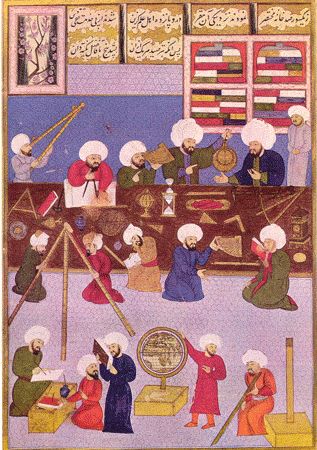
The traditional image of the Bayt al-Hikma , or House of Wisdom, captures Baghdad's reputation as a center of learning, but the larger historical process was broader than one institution. Translation was carried out through networks of scholars and patrons, and Christian and Jewish scholars as well as Muslim scholars participated in the intellectual culture. The result was not merely a warehouse of Greek texts. It was the creation of an Arabic philosophical vocabulary capable of discussing logic, causation, substance, intellect, nature, and being.
Al-Kindi and Al-Farabi: From Translation to Philosophy
Al-Kindi stands near the beginning of the classical falsafa tradition. He helped integrate Greek philosophical and scientific learning into Arabic intellectual culture, drawing on Aristotelian and Neoplatonic materials while developing arguments of his own. His significance lies partly in showing that translation was only the beginning: Greek philosophy could become a resource for original philosophical inquiry in a new linguistic and religious setting.
Al-Farabi developed this project further. His work on logic, the classification of the sciences, metaphysics, political philosophy, and the relation between philosophy and religion helped establish a systematic philosophical curriculum. His reputation as the “Second Teacher,” after Aristotle, reflects the later tradition's assessment of his importance as an interpreter and system-builder.
Avicenna: Aristotle Rebuilt From Within
Avicenna —Ibn Sina—did not merely explain Aristotle. He constructed a comprehensive philosophical system that absorbed, revised, and sometimes departed from Aristotelian positions. His Healing ( al-Shifa' ) organized a vast range of philosophical disciplines, while his metaphysics developed influential arguments about contingency, necessity, essence, and existence.
This is one of the central reasons the word “preservation” can be misleading. Avicenna's philosophy shows what happens when a thinker inherits a tradition deeply enough to transform it. Aristotle supplied many of the conceptual problems and texts, but Avicenna's answers became important in their own right and later influenced Jewish and Latin Christian philosophers.
Averroes: “The Commentator”
Averroes —Ibn Rushd—made Aristotle the center of an unusually sustained interpretive project. Working in al-Andalus, he produced short, middle, and long commentaries on Aristotle's works. He sought to clarify Aristotle's arguments and, in many cases, to recover what he regarded as Aristotle's philosophical position against later interpretations.
His importance in the Latin West became especially pronounced because his commentaries were translated into Latin and became major secondary sources for university scholars. In this sense, medieval Latin readers often encountered Aristotle together with an Arabic philosopher's interpretation of Aristotle. The intellectual chain was therefore not simply Greek text → Latin Europe ; it could be Greek text → Arabic translation → Arabic commentary → Latin translation → European university .
How Aristotle Returned to Latin Europe
From the twelfth century onward, translation into Latin accelerated. Toledo became one important center for translating Arabic philosophical and scientific texts, while Sicily and southern Italy also played significant roles. Some translators worked from Arabic versions of Aristotle; others increasingly translated directly from Greek manuscripts as Greek texts became more available in the West.
This is an important correction to the oversimplified story that Europe recovered Aristotle solely through Arabic. The Arabic-Latin translations were enormously important, but they were one part of a wider process that also included direct Greek-to-Latin translation and the circulation of texts through Byzantium and other Mediterranean networks. The Aristotelian corpus reached medieval Latin scholars through several routes.
Why “Saved Aristotle” Is Only Part of the Story
The title of this article is deliberately dramatic, but the historical reality is more interesting than the slogan. Arabic-speaking philosophers did not merely preserve an unchanged Aristotle for Europeans. They produced new arguments, commentaries, classifications, metaphysical distinctions, and interpretations. They also transmitted material from other Greek traditions, including Neoplatonism, which sometimes became intertwined with the reception of Aristotle.
There was also no single moment when “the West” suddenly rediscovered Aristotle. Different works entered Latin intellectual life at different times, through different translators and languages. Some works were available earlier through Boethius; others arrived through Arabic; still others were translated directly from Greek. The history is best understood as a series of overlapping transmission routes rather than a single rescue mission.
Why This Transmission Changed Philosophy
By the thirteenth century, Aristotle had become central to the curriculum of Latin European universities, and Arabic philosophers had significantly shaped how many of his problems were understood. The influence extended beyond metaphysics into natural philosophy, psychology, logic, and ethics. Thinkers such as Avicenna and Averroes became interlocutors for Latin philosophers rather than invisible intermediaries.
The deeper lesson is about how intellectual traditions survive. A philosophical work survives not only because someone stores its pages. It survives when translators make it readable, teachers make it teachable, commentators make its arguments intelligible, and later thinkers find reasons to disagree with it. Aristotle's journey through the Arabic-speaking world is therefore not a footnote to European philosophy. It is part of the history of how philosophical ideas become durable across languages and civilizations.
Frequently Asked Questions
Did Islamic philosophers really “save” Aristotle?
They played a major role in transmitting Aristotle's works and developing Aristotelian philosophy in Arabic, but “saved” is a simplification. Greek, Syriac, Arabic, Byzantine, Jewish, and Latin traditions all contributed to the survival and later circulation of the Aristotelian corpus.
What was the House of Wisdom?
The House of Wisdom, or Bayt al-Hikma , is traditionally associated with Abbasid Baghdad and its culture of learning. Modern scholarship cautions against treating it as a single institution responsible for the entire translation movement; the broader process involved multiple scholarly circles, translators, patrons, and institutions.
Who was al-Kindi?
Al-Kindi was an early major philosopher of the Arabic falsafa tradition. He helped introduce and integrate Greek philosophical and scientific ideas into Arabic intellectual culture while developing philosophical arguments of his own.
Why is Avicenna important to Aristotle's reception?
Avicenna absorbed Aristotelian philosophy into a comprehensive system of his own. His work on metaphysics, logic, psychology, and natural philosophy became influential in Arabic, Jewish, and Latin intellectual traditions.
Why was Averroes called “the Commentator”?
Averroes produced extensive commentaries on Aristotle's works, including different levels of commentary designed for different readers. His interpretations became highly influential in medieval Latin philosophy after they were translated into Latin.
How did Aristotle reach medieval European universities?
Aristotle's works reached Latin Europe through several routes. Arabic-to-Latin translations in places such as Toledo and Sicily were important, but direct Greek-to-Latin translations also became increasingly significant in the twelfth and thirteenth centuries. Arabic philosophers and commentators strongly influenced how Aristotle was read.