What makes a government legitimate and effective? Is a stable society built primarily by good people doing the right thing, or by a system of rules that works even when the people in charge are not especially good? More than two thousand years ago, thinkers in ancient China confronted versions of exactly this problem.
The debate is often presented as a simple opposition between Confucianism and Legalism. Confucian thought emphasizes moral cultivation, ritual, education, relationships, and the character of rulers. Legalist thinkers, especially Han Feizi, emphasized clear standards, administrative techniques, rewards and punishments, and institutions capable of producing order without depending on an unusually virtuous ruler.
That contrast is useful, but it can become misleading if it turns into a story of two completely separate camps. The Warring States period produced overlapping arguments about human nature, political authority, social hierarchy, education, military power, and the conditions under which a state can survive. Xunzi, for example, stands in an especially important position between Confucian moral cultivation and the harder assumptions about human motivation that later became associated with Legalist statecraft.
The Warring States Problem: How Do You Make Order Durable?
The intellectual background of the debate was a period of political fragmentation and warfare in ancient China commonly known as the Warring States period. Rival states competed for territory, resources, military advantage, and political survival. The older political order associated with the Zhou world was under severe strain, while rulers increasingly needed practical methods for administration and warfare.
Philosophy therefore became closely connected with the practical problem of governing. Thinkers were not merely asking what an ideal human being looks like. They were also asking how a ruler should organize officials, how social roles should function, how people could be educated, what makes authority legitimate, and what should happen when subjects refuse to obey. These questions gave ancient Chinese philosophy an unusually strong political and institutional dimension.
Within this environment, different traditions proposed different diagnoses. Some thinkers believed political disorder reflected failures of moral cultivation and leadership. Others argued that rulers could not safely depend on moral virtue because human behavior was too variable and political competition too unforgiving. The disagreement was therefore not simply about whether laws were useful. It concerned what a political system should fundamentally rely upon.
Confucius: Govern Through Virtue, Not Mere Coercion
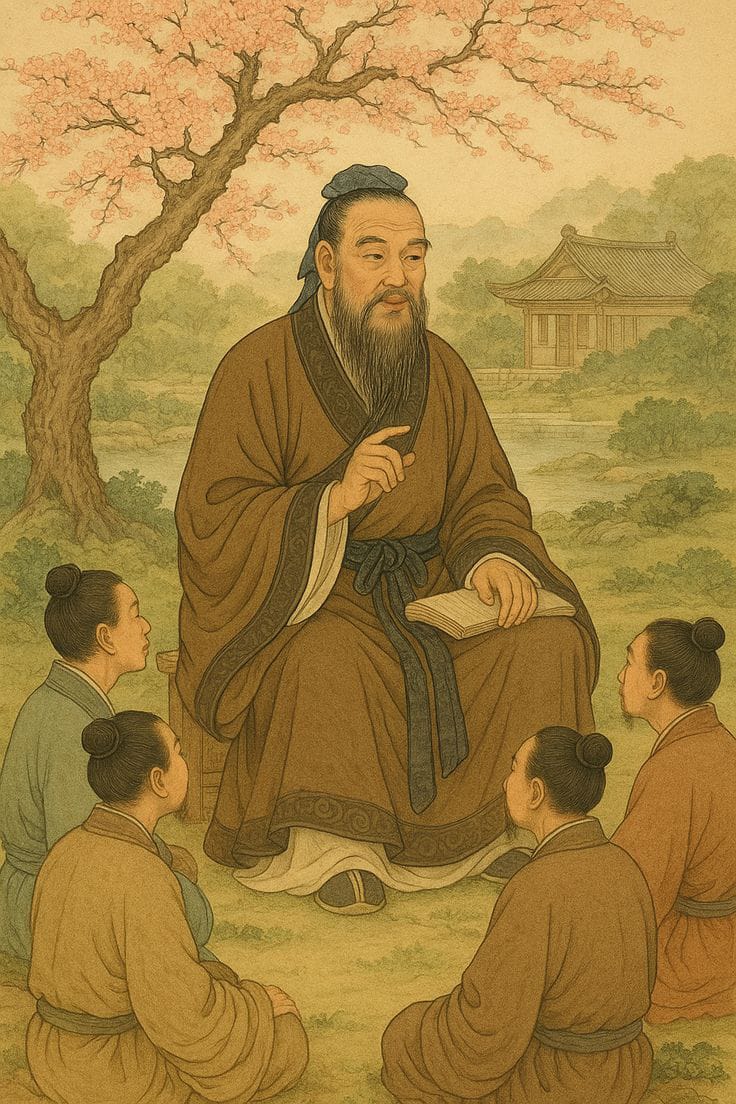
Confucius approached politics through the cultivation of character. In the Analects, good government is connected to the moral quality of the people who occupy social and political roles. A ruler cannot simply demand good conduct from everyone else while treating his own conduct as irrelevant. Political authority has an educative dimension: the behavior of those at the top helps establish the norms that others learn to follow.
This is why Confucian political thought places such importance on the ruler as a moral example. The ideal ruler does not govern only through threats. He cultivates de, often translated as moral virtue or moral power, and creates conditions in which people can develop a sense of appropriate conduct. Confucius contrasts this with governing through punishments alone: punishment may produce outward compliance without producing the internal sense of shame and responsibility that makes order durable.
The point should not be reduced to the claim that Confucius simply wanted governments to abolish law. His political thought is better understood as placing law and punishment inside a larger moral framework. Rules can regulate behavior, but they do not by themselves create the dispositions, relationships, habits, and judgments required for a flourishing social order.
For Confucius, the deepest form of political order begins before punishment: it begins with the formation of character.
Ritual and Ren: How Does Character Become Political?
One of the most important Confucian concepts is li, commonly translated as ritual, rites, or ritual propriety. The word is broader than the modern English idea of a religious ceremony. In early Confucian contexts, it can encompass formal rituals, etiquette, social conventions, family obligations, and appropriate behavior within different relationships. The important philosophical question is why such practices matter.
Confucius treats ritual as a form of moral training. Repeatedly acting with respect, restraint, attentiveness, and consideration can shape the dispositions from which future actions arise. In this sense, ritual is not merely external performance. It can become a method of cultivating the person who performs it. Modern interpretations of Confucian ethics often emphasize precisely this connection between habituation, social practice, and character formation.
Closely related is ren, often translated as benevolence, humaneness, or human-heartedness. The concept is difficult to reduce to a single English word because it concerns how a person learns to respond to others appropriately and humanely. Confucian political order therefore cannot be separated neatly from personal ethics: the quality of public life depends on the quality of relationships and the dispositions of the people participating in them.
This produces a distinctive political theory. Instead of imagining society as a collection of isolated individuals who need to be restrained by an external authority, Confucianism emphasizes relationships and roles. People learn how to act by learning what is appropriate for a child, parent, friend, teacher, student, official, or ruler. The ethical person is not simply someone who knows abstract rules; the ethical person develops the practical judgment to respond appropriately within a concrete relationship.
From Family Order to Political Order
Confucian political thought gives the family a foundational role. The practice of filial respect is not treated as a private matter completely disconnected from political life. It becomes part of a broader account of how people learn responsibility, reciprocity, hierarchy, and care.
This does not mean that Confucianism simply says a state is identical to a family. Rather, the family provides a model through which social responsibilities can be understood. If people learn to take obligations seriously in intimate relationships, those habits can extend outward into wider forms of social and political responsibility.
Confucius also inherited and transformed older ideas concerning the Mandate of Heaven. Political authority was not understood as permanently justified merely because a ruler happened to possess power. Moral failure could undermine the legitimacy of rule. The political order therefore carried a normative dimension: successful government was connected to the ruler's ability to act appropriately and maintain a morally defensible relationship with the people.
The result is a conception of government in which administration and ethics cannot be completely separated. A state may possess procedures and institutions, but the character of officials still matters because institutions are operated by human beings.
Legalism: Assume Imperfect Motives, Then Design Accordingly
Legalist thinkers began from a more skeptical assessment of political reliability. The tradition commonly called Legalism encompasses several Warring States thinkers and arguments rather than a single founder or perfectly unified doctrine. Its most systematic surviving theorist is Han Feizi, whose political thought emphasizes the construction of institutions capable of controlling behavior and maintaining state power.
The crucial insight is institutional rather than psychological in the Confucian sense. A ruler should not build the survival of the state around the assumption that every official will be virtuous, loyal, selfless, or wise. People respond to incentives, pursue interests, compete for office, and make mistakes. A durable political system therefore needs standards that can operate despite these limitations.
Legalist statecraft consequently places heavy emphasis on clear standards, administrative hierarchy, predictable rewards and punishments, and the ruler's ability to maintain control over officials. The objective is not necessarily to make everyone morally excellent. It is to make political behavior sufficiently predictable that the state can function.
This gives Legalism a very different answer to the question of political trust. Confucianism asks how people can be cultivated into better participants in a moral community. Legalism asks what kind of institutions remain effective when the people operating inside them are ordinary, ambitious, self-interested, or flawed.
Han Feizi: Institutions Over the Personality of the Ruler
Han Feizi represents the Legalist concern with political technique in its most developed form. His writings repeatedly confront a basic danger: if government depends on the personal virtue of a particular ruler, what happens when that ruler is mediocre, selfish, or incompetent?
The Legalist response is to make the political system less dependent on exceptional personalities. Offices should carry defined responsibilities; officials should be evaluated according to performance; standards should be clear; and rewards and punishments should create incentives that align individual behavior with the interests of the state.
This is one reason Legalism can look surprisingly modern in certain respects. Its question is recognizably institutional: how can a system be designed so that it does not collapse when individuals fail? But the comparison has limits. Ancient Chinese Legalism developed in the context of centralized monarchy, interstate warfare, and a very different conception of political authority. It should not simply be translated into modern constitutional or democratic categories.
Xunzi: The Uncomfortable Bridge Between Confucianism and Legalism
The sharpest version of the Confucian-versus-Legalist story becomes difficult to maintain once Xunzi enters the picture. Xunzi belonged to the Confucian intellectual tradition but offered a notably pessimistic account of untrained human tendencies. He argued that human beings naturally pursue desires and that moral order therefore requires education, deliberate practice, ritual, and institutional shaping.
His position is significant because it shows that confidence in ritual and moral education does not require an optimistic belief that people will spontaneously become good. Moral character can be something constructed through disciplined practice. In this respect, Xunzi shares with Legalist thinkers a concern about uncontrolled desire while retaining the Confucian commitment to education and ritual cultivation.
Xunzi's intellectual relationship to later Legalist figures is also historically important. Han Feizi and Li Si are traditionally associated with having studied under Xunzi, although the intellectual transmission between these thinkers should not be treated as proof that Xunzi simply "became" a Legalist. His own project remained deeply committed to the Confucian classics, ritual, and moral education.
The Qin Experiment: When Legalist Statecraft Met Empire
The Qin state provides the most famous historical case associated with Legalist political techniques. Through military expansion and centralized administration, Qin defeated its rivals and established imperial unity in 221 BCE. Figures such as Li Si played major roles in Qin administration and the consolidation of centralized rule.
The achievement was extraordinary. A political system capable of mobilizing resources, organizing large populations, enforcing standards, and coordinating territory had helped transform a competitive state into an empire. The Qin experience therefore demonstrates why strong administrative institutions could appear attractive in a world dominated by warfare.
Yet the Qin dynasty was short-lived. It fell in 206 BCE, only a few years after the death of its first emperor. It would be too simple to explain the collapse with a single philosophical cause, because rebellion, succession problems, political conflict, and the burdens of the imperial system all mattered. Still, the Qin experience became a powerful historical lesson about the limits of coercion and the political costs of excessive severity.
The important philosophical point is not that Legalism "failed" while Confucianism "succeeded." The Qin state demonstrated the power of centralized administration, while its collapse demonstrated that state capacity alone does not guarantee political durability.
The Han Settlement: Confucian Ideals, Administrative Power
The Han dynasty that followed the Qin developed a different political balance. Confucian learning became increasingly important to the ideological and educational life of the state, while centralized institutions, administrative structures, taxation, law, and bureaucracy remained essential to governing a large territory.
This is why the popular phrase "Confucian on the outside, Legalist on the inside" can be useful as a shorthand, provided it is not treated as a precise description of every aspect of Han government. The historical development was more complicated than two philosophies simply being mixed together. Confucian thinkers themselves disagreed about law, punishment, hierarchy, human nature, and the proper role of government.
Nevertheless, the Han experience illustrates a recurring political reality: moral ideals and institutional mechanisms can perform different functions. A government may use education and moral language to define desirable conduct while simultaneously relying on laws, offices, bureaucratic procedures, and sanctions to make administration possible.
Confucianism vs. Legalism: The Core Differences
| Question | Confucian Approach | Legalist Approach |
|---|---|---|
| What creates order? | Moral cultivation, ritual, relationships, education, and exemplary leadership. | Clear standards, administration, incentives, rewards, punishments, and state capacity. |
| View of human conduct | People can be educated and cultivated through social and moral practices. | Political systems should account for self-interest and unreliable motives. |
| Ideal ruler | A morally cultivated exemplar whose conduct influences the wider society. | A ruler who maintains effective institutions and controls administrative power. |
| Role of ritual | Central to character formation, relationships, and social harmony. | Secondary to administrative standards and mechanisms of control. |
| Role of punishment | Not the preferred foundation of moral order; excessive reliance can produce avoidance rather than virtue. | A legitimate and necessary instrument for making standards effective and behavior predictable. |
| Main political risk | Dependence on exceptional virtue or ineffective rulers and officials. | Excessive coercion, concentration of power, and the human cost of rigid enforcement. |
The table shows why the disagreement is deeper than "good government versus bad government." Each tradition identifies a different source of political fragility. Confucianism worries about the moral emptiness of obedience produced only by fear. Legalism worries about the institutional weakness created when a state assumes that rulers and officials will reliably behave well.
The most interesting political question may therefore be whether these concerns can be separated at all. A government needs institutions, but institutions are operated by people. It needs rules, but rules require interpretation and enforcement. It needs authority, but authority can become abusive. It needs citizens who understand obligations, but education and shared norms cannot replace every formal rule.
Why This Ancient Debate Still Matters
The Confucian-Legalist disagreement remains useful because it identifies a problem that appears in almost every theory of government: how much should a political system depend on the character of the people within it?
A system built entirely around trust and civic virtue can become fragile if citizens or leaders stop sharing the norms on which it depends. A system built almost entirely around surveillance, sanctions, and rigid enforcement can become brittle in the opposite direction: people may obey without developing trust, responsibility, or identification with the political order.
This is where the debate connects naturally with political philosophy and philosophy of law. Modern constitutional states generally use enforceable rules while also depending on informal norms such as honesty, professional ethics, civic responsibility, and trust. Institutions can constrain misconduct, but no legal system can specify every good action a person should take.
The debate is also relevant to the design of public institutions. Should institutions assume that officials will act responsibly, or should they be designed with conflicts of interest and self-interest in mind? Should education aim merely to produce compliance, or should it cultivate judgment? Should punishment be primarily deterrence, retribution, rehabilitation, or some combination? These are modern questions, but their underlying structure is remarkably old.
Contemporary scholarship also cautions against turning ancient traditions into simple political labels. Confucianism has developed in many directions, and modern Confucian thinkers have explored relationships between classical ideals, constitutionalism, democracy, and institutional safeguards. The history therefore gives us concepts to think with rather than a ready-made political program.
Conclusion: Good Government Needs More Than One Ingredient
Confucius and the Legalists began from different intuitions about what makes political order possible. Confucius placed moral cultivation, education, ritual, relationships, and exemplary leadership at the center. Legalist thinkers emphasized institutional design, administrative control, incentives, standards, and enforceable sanctions.
The historical record does not provide a simple winner. The Qin experience demonstrated the extraordinary capacity of centralized statecraft while also revealing the dangers of a system that could impose heavy demands on society. The Han period demonstrated how moral and educational ideals could coexist with durable bureaucratic and legal institutions.
Perhaps the most valuable lesson is therefore not to choose one side too quickly. Political institutions need rules because people are imperfect. They also need trustworthy people because rules cannot administer themselves. Law can establish boundaries, but education and culture influence how people behave when no one is watching.
That tension is the enduring philosophical problem. Confucianism asks what kind of people a society should cultivate; Legalism asks what kind of institutions a state needs when people cannot be trusted to be ideal. Between those two questions lies much of the continuing problem of governance itself.
Frequently Asked Questions
What is the main difference between Confucianism and Legalism?
Confucian political thought emphasizes moral cultivation, ritual, relationships, education, and rulers who lead by virtuous example. Legalist thought emphasizes institutions, clear standards, administrative control, and reliable rewards and punishments because political order should not depend on the exceptional virtue of individual rulers.
What did Confucius think made a good ruler?
Confucius presented good government as closely connected to the ruler's own moral character. A ruler should cultivate virtue, practice ritual propriety, treat people with care, and govern in a way that encourages moral development rather than relying primarily on coercive punishment.
What is Legalism in ancient Chinese philosophy?
Legalism is a name used for a group of Warring States political thinkers associated with strong state institutions, administrative techniques, clear standards, and the use of rewards and punishments to regulate conduct. Han Feizi is its most systematic surviving theorist.
Which dynasty is most closely associated with Legalism?
The Qin dynasty is most closely associated with Legalist statecraft. Under Qin rule, especially through figures such as Li Si, Legalist ideas about centralized administration, standards, and coercive state power were implemented on a large scale during the unification of China in 221 BCE.
Did Confucianism defeat Legalism?
Not in a simple sense. The Han dynasty gave Confucian learning a central ideological and educational role while retaining many centralized administrative and legal practices associated with earlier statecraft. The longer history is better understood as interaction and synthesis than as a clean victory of one philosophy over the other.
Why is the Confucianism versus Legalism debate important today?
The debate highlights a continuing political question: should social order depend mainly on character, shared norms, education, and trust, or on institutions, rules, incentives, and enforcement? Modern states generally rely on combinations of both, although the balance differs across political systems.
Sources and Further Reading
For further scholarly reading on Confucius, ritual, virtue, and political thought, see the Stanford Encyclopedia of Philosophy entry on Confucius. For a broader treatment of ritual and Chinese ethics, see the Stanford Encyclopedia of Philosophy overview of Chinese ethics.
This article is an interpretive overview rather than a translation of any primary text. Concepts such as li, ren, virtue, law, and Legalist statecraft have complex histories and are debated by scholars.