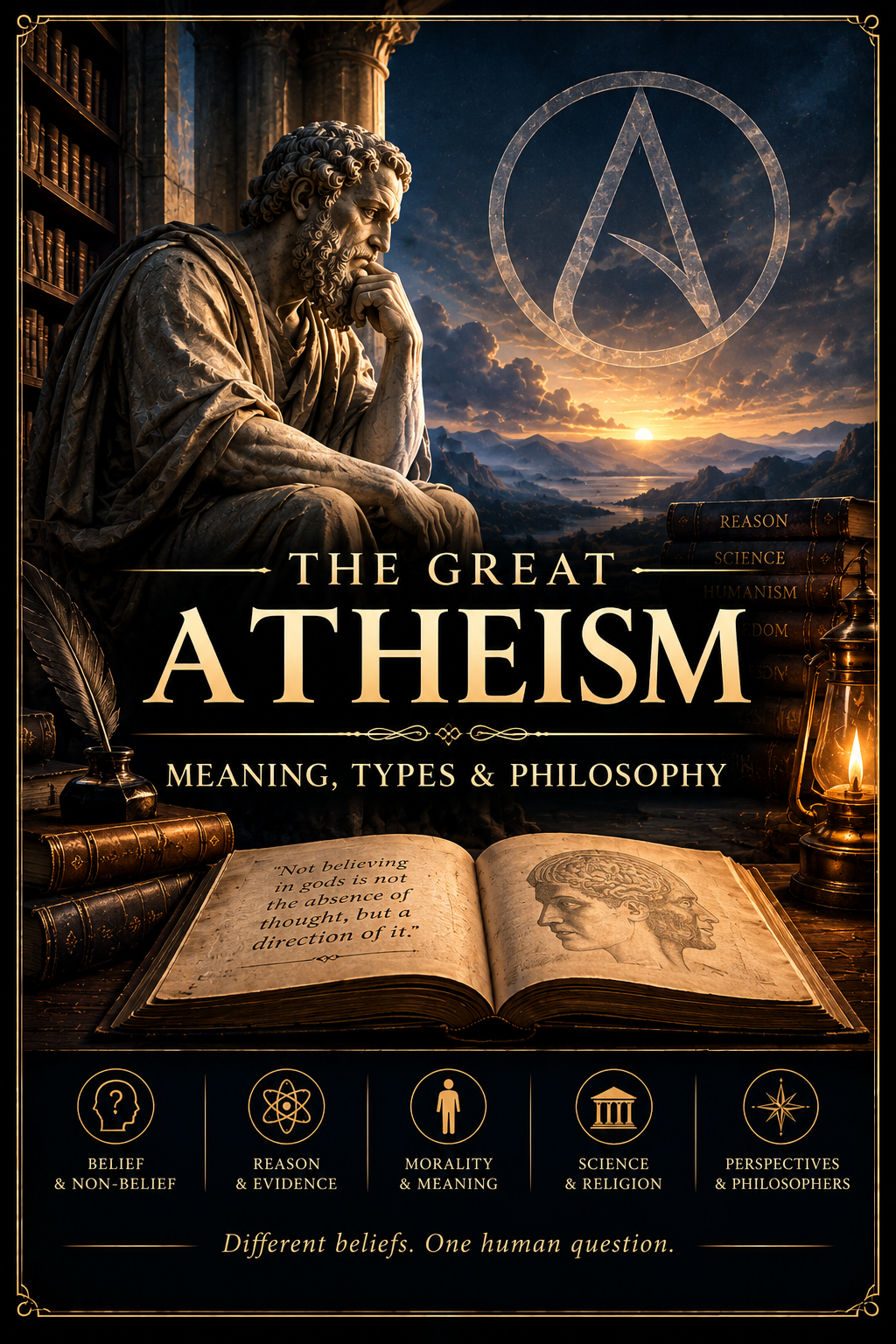
What Is Atheism?
Atheism is a philosophical position concerning the existence of gods. In philosophy of religion, the term is commonly used for the denial that God or gods exist. In broader contemporary usage, however, atheism can also refer to the absence of theistic belief. These two uses are related but should not be treated as identical without stating which definition is intended.
Atheism is therefore not, by itself, a complete theory of morality, politics, science, or human nature. A person can be an atheist while defending very different positions in ethics and metaphysics. The philosophical questions surrounding atheism include whether God exists, what counts as evidence for or against theism, whether God's existence can be known, and whether moral or existential commitments require a religious foundation.
Atheism: Quick Facts
- Field
- Philosophy of religion, metaphysics, and epistemology
- Central question
- Does God or any god exist?
- Atheism
- A position rejecting the existence of gods, or in broader usage, lacking theistic belief
- Theism
- The position that one or more gods exist
- Agnosticism
- A position concerning whether the existence of God is known, justified, or knowable
- Common classifications
- Weak/strong, negative/positive, and implicit/explicit atheism
- Related concepts
- Naturalism, secularism, humanism, skepticism, nihilism, and philosophy of religion
- Important distinction
- Atheism concerns belief or existence; agnosticism primarily concerns knowledge or epistemic status
What Does Atheism Mean?
The meaning of atheism depends partly on how the term is being used. A common philosophical definition treats atheism as the proposition or position that God does not exist. Another widely used definition describes atheism as the absence of belief in God or gods. Because both usages occur in contemporary discussion, a careful reference page should identify the sense being used rather than assuming that all atheists understand the label in exactly the same way.
The distinction is especially important when atheism is compared with agnosticism. If atheism is defined as a claim about God's nonexistence, it addresses a metaphysical question. Agnosticism, by contrast, is usually concerned with whether God's existence or nonexistence is known, justified, or knowable. This is why the labels can overlap in ordinary usage: someone may reject belief in God while remaining uncertain about whether God's nonexistence can be established with certainty.
What Do Atheists Believe?
Atheism alone tells us relatively little about everything else a person believes. It addresses the question of gods, but it does not by itself determine a person's theory of knowledge, morality, politics, science, consciousness, or meaning. Two atheists can therefore agree about the nonexistence of gods while disagreeing substantially about almost every other philosophical question.
Some atheists also defend naturalism, the view that reality contains no supernatural entities or processes. Others identify with secular humanism, moral realism, existentialism, materialism, physicalism, skepticism, or entirely different philosophical positions. None of these positions follows from atheism by definition.
For the same reason, atheism should not automatically be equated with hostility toward religion. An atheist may reject religious belief while still studying religious traditions, participating in cultural practices, or considering religious ideas historically and philosophically important. The content of an individual's broader worldview has to be examined separately from the question of belief in gods.
What Are the Types of Atheism?
Philosophers and writers use several classifications to distinguish different forms of atheism. The terminology is not completely uniform, so these labels should be treated as analytical categories rather than a single universally accepted taxonomy.
| Term | Basic meaning | Main distinction |
|---|---|---|
| Weak atheism | Lack of belief in gods | Does not necessarily assert that gods do not exist |
| Strong atheism | Belief or assertion that gods do not exist | Makes a stronger metaphysical claim |
| Negative atheism | Absence or rejection of theistic belief | Often used broadly for non-belief |
| Positive atheism | Affirmation that no gods exist | Often overlaps with strong atheism |
| Implicit atheism | Atheistic status without an explicit decision to reject theism | Often concerns people who have not formed a theistic belief |
| Explicit atheism | Conscious rejection of theistic belief | Involves an explicit position or judgment |
These classifications can overlap. For example, a person may describe themselves as an explicit atheist while also being agnostic about whether atheism can be known with certainty. The labels are most useful when the question being addressed is made explicit.
What Is Agnostic Atheism?
Agnostic atheism is a position that combines an atheistic stance with agnosticism about knowledge or certainty. In common usage, an agnostic atheist does not believe in God or gods while also declining to claim that God's nonexistence is known with absolute certainty.
This combination is possible because atheism and agnosticism can address different questions. Atheism concerns belief in gods or, under a stronger definition, the truth of the claim that gods do not exist. Agnosticism concerns whether the relevant claim is known, justified, or knowable. Consequently, describing someone as both atheist and agnostic is not necessarily contradictory.
Atheism vs Theism vs Agnosticism
The relationship among atheism, theism, and agnosticism becomes clearer when belief and knowledge are treated as separate dimensions. Theism and atheism primarily concern the existence of gods, while agnosticism is commonly used to describe a position about what can be known or justified regarding that question.
| Position | Core question | Basic position |
|---|---|---|
| Theism | Does a god or gods exist? | Affirms the existence of one or more gods |
| Atheism | Does a god or gods exist? | Rejects or lacks belief in gods, depending on the definition |
| Agnosticism | Can the existence of God be known or justified? | Withholds or qualifies claims about knowledge or epistemic status |
| Agnostic theism | Belief and knowledge | Believes in God while not claiming certainty or knowledge |
| Agnostic atheism | Belief and knowledge | Does not believe in God while not claiming certainty about God's nonexistence |
These labels are descriptive frameworks rather than a complete map of every possible philosophical position. The precise definitions of atheism and agnosticism remain subjects of philosophical discussion.
How Do Belief and Knowledge Relate?
A useful way to understand the terminology is to separate two questions: what a person believes and what they claim can be known. This avoids the common mistake of treating atheism and agnosticism as simple opposites.
Two dimensions of the debate
Belief
Does the person believe that one or more gods exist?
Knowledge
Does the person claim that God's existence or nonexistence is known or knowable?
Combined positions
The two dimensions can be combined to describe more specific positions.
Key point: The terminology varies among authors, so the definitions used in a particular discussion should always be made explicit.
Is Atheism a Religion?
Atheism is generally not classified as a religion. A religion typically involves some combination of beliefs, practices, rituals, institutions, traditions, sacred narratives, or forms of worship. Atheism, by contrast, is primarily a position concerning the existence of gods and does not by itself prescribe a system of worship or a complete set of religious practices.
This does not mean that atheists cannot form communities, adopt ethical commitments, participate in ceremonies, or develop secular institutions. It means that these additional practices are not implied by atheism alone. Whether a particular secular organization should be described as religious is a separate classificatory question.
Atheism and Morality
Atheism does not itself provide a complete theory of morality. The philosophical question of whether moral facts, duties, or values require God is separate from the question of whether God exists. Atheists have therefore defended many different ethical theories, including consequentialism, deontology, virtue ethics, contractualism, and forms of moral realism and anti-realism.
One major debate in philosophy of religion concerns whether objective morality depends on a divine source. Divine command theories, natural-law approaches, secular moral realism, constructivism, and other theories give different answers. The existence of disagreement among atheists and theists about these questions shows why atheism itself should not be treated as a complete ethical doctrine.
Atheism, Meaning, and Nihilism
Atheism is sometimes associated with nihilism because both appear in debates about religion and meaning. Philosophically, however, they are different positions. Atheism concerns the existence of gods, while nihilism is a family of positions that may deny or question objective meaning, value, knowledge, or other forms of significance.
An atheist can therefore hold that life has meaning, that human projects have value, or that objective moral truths exist. Conversely, a person could reject a particular religious conception of God without accepting nihilism. Existentialist philosophers have explored these questions in different ways, including the possibility of creating or discovering meaning without appealing to a divine foundation.
Atheism in Philosophy
Atheism belongs primarily to philosophy of religion, but its implications intersect with metaphysics, epistemology, ethics, philosophy of science, and existential philosophy. Philosophers ask not only whether God exists but also what would count as evidence, whether divine attributes are coherent, whether religious experience provides justification, and what follows if theistic claims are false.
Philosophical discussions of atheism also distinguish the rejection of theism from broader positions such as naturalism and materialism. Atheism does not logically require either view. A philosopher can reject the existence of gods without committing themselves to every claim associated with physicalism, naturalism, or any particular scientific theory.
This makes atheism a useful entry point into wider philosophical debates: the existence of God, the nature of explanation, the relationship between faith and reason, the problem of evil, divine hiddenness, religious epistemology, and the possibility of secular foundations for morality and meaning.
History of Atheism
The history of atheism is not a simple story of one continuous movement. Terms for disbelief in gods developed in different cultural and philosophical settings, and accusations of atheism have often meant different things in different historical periods. It is therefore useful to distinguish ancient criticism of traditional gods from later explicit philosophical arguments for atheism.
Criticism of traditional religion
Greek philosophers and poets sometimes criticized conventional accounts of the gods, questioned divine attributes, or proposed naturalistic explanations of the world. Such positions should not automatically be equated with modern atheism.
New debates about reason, religion, and nature
The growth of modern philosophy and science changed debates about religious authority, evidence, causation, and the relationship between faith and reason.
Explicit philosophical criticism
Enlightenment and post-Enlightenment thinkers developed increasingly explicit criticisms of traditional theism, while debates about materialism, naturalism, morality, and religion became more systematic.
Analytic, existential, and secular approaches
Contemporary philosophy has examined atheism through arguments about evidence, divine hiddenness, evil, religious language, rationality, naturalism, and the epistemology of religious belief.
Arguments About the Existence of God
Philosophical atheism is often discussed through arguments about the existence or nonexistence of God. These arguments do not all share the same premises or aim at the same conclusion. Some challenge particular conceptions of God; others argue about evidence, probability, or the explanatory role of theism.
| Argument or issue | Central question | Relation to atheism |
|---|---|---|
| Cosmological arguments | Does the existence of the universe require a first cause or necessary being? | Atheistic critiques question whether such arguments establish a divine being |
| Teleological arguments | Does order, design, or apparent fine-tuning support theism? | Atheistic responses examine alternative explanations and the evidential strength of design claims |
| Ontological arguments | Can the existence of God follow from the concept of a maximally great or necessary being? | Critiques challenge the premises, modal reasoning, or move from concept to existence |
| Problem of evil | How is severe or apparently gratuitous evil compatible with an omnipotent, omniscient, and perfectly good God? | Used in arguments against particular forms of theism |
| Divine hiddenness | Why would a perfectly loving God remain hidden from sincere nonbelievers? | Raises an evidential challenge to some forms of theism |
The existence of an argument against theism does not by itself settle every question about atheism. Likewise, an argument for theism may target a specific conception of God rather than every possible form of theism. Philosophical analysis therefore depends on the exact premises and definitions involved.
Atheism vs Christianity
Christianity and atheism differ most fundamentally over belief in God. Christianity is a theistic religious tradition centered on belief in God and on claims about Jesus Christ, revelation, salvation, and Christian scripture and tradition. Atheism rejects or lacks belief in gods, depending on the definition being used.
The comparison becomes broader when it reaches morality, human nature, salvation, meaning, and the afterlife. Christianity contains multiple theological and philosophical traditions, while atheism does not prescribe a single alternative worldview. Consequently, an “atheism vs Christianity” comparison should distinguish questions about God's existence from questions about ethics, culture, history, and existential meaning.
Atheism vs Islam
Islam and atheism differ fundamentally over belief in God. Islam is a monotheistic religious tradition centered on belief in Allah, prophecy, revelation, and the Qur'an, while atheism rejects or lacks belief in gods depending on the definition being used.
A philosophical comparison can examine additional questions about revelation, reason, morality, human purpose, religious authority, and the afterlife. Islam itself contains diverse theological and philosophical traditions, so a careful comparison should avoid treating either “Islam” or “atheism” as a completely uniform worldview.
Atheism and Science
Atheism and science are related in some historical and philosophical discussions, but they are not identical concepts. Science investigates empirical questions using observation, experimentation, modeling, and other methods. Atheism is a position about the existence of gods, which is generally treated as a metaphysical or philosophical question rather than a straightforward empirical hypothesis.
Some atheists defend naturalism and regard scientific explanation as part of a broader naturalistic worldview. Other atheists do not make such a strong philosophical commitment. Likewise, scientific practice by itself does not automatically establish atheism. Questions about the existence of God often involve metaphysics, epistemology, and philosophy of religion in addition to empirical science.
Common Misconceptions About Atheism
Atheism FAQ
Sources and Further Reading
The following scholarly references provide background for the definitions, distinctions, and historical framing used on this page.
Why Is Atheism an Important Philosophical Topic?
Atheism is important in philosophy because it addresses a central question of philosophy of religion: whether God or gods exist. Its analysis also leads to broader questions about evidence, knowledge, metaphysics, morality, meaning, religious experience, and the relationship between faith and reason.
The term itself requires careful definition. In philosophical literature, atheism is often treated as the denial of God's existence, while broader contemporary usage may describe the absence of theistic belief. The distinction between atheism and agnosticism is similarly important because belief and knowledge are not necessarily the same question.
Atheism also does not dictate a complete worldview. Atheists can disagree about ethics, politics, science, consciousness, meaning, and the nature of reality. Understanding atheism therefore requires examining the particular arguments and philosophical commitments that accompany a person's position rather than treating atheism as a single comprehensive doctrine.