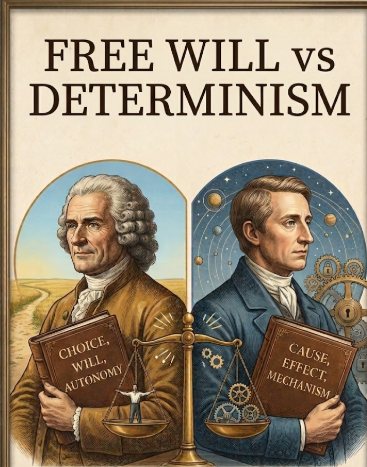
Free Will vs Determinism
The debate between free will and determinism asks whether human choices are genuinely up to the person making them, or whether every decision is the necessary outcome of prior causes operating according to natural law. The question matters because so much of ordinary life — praise, blame, punishment, regret, and pride in achievement — seems to assume that people could, in some meaningful sense, have done otherwise.
Philosophers have not settled on a single answer. Some argue that free will and determinism are compatible; others hold that they cannot both be true, and then divide over which one they think is actually the case. This page lays out the core definitions, the major positions, their history, and how the debate connects to moral responsibility and everyday decisions.
Free Will vs Determinism: Quick Facts
- Field
- Metaphysics, philosophy of mind, and ethics
- Central question
- Are human choices genuinely free, or fully caused?
- Free will
- The capacity to choose between different possible courses of action
- Determinism
- The thesis that every event follows necessarily from prior causes and natural law
- Main positions
- Compatibilism, hard determinism, libertarian free will, and incompatibilism
- Key connected issue
- Moral responsibility, praise, blame, and punishment
- Important distinction
- Whether free will requires the falsity of determinism is itself disputed
History of Free Will and Determinism
The question of whether human beings act freely or are bound by necessity has been discussed since antiquity, though the terms used to frame it have shifted across periods. Ancient thinkers were often concerned with fate, causation, and virtue; later philosophers reframed the debate around natural law, divine foreknowledge, and, eventually, physical determinism.
Ancient Greek philosophy already contained the seeds of the debate. Aristotle discussed voluntary and involuntary action and treated deliberation and choice as central to ethics, while Stoic philosophers developed accounts of fate and providence that raised early versions of the compatibility question.
In the medieval period, the problem was often tied to theology: if God has complete foreknowledge of the future, philosophers such as Augustine and Aquinas asked whether human choices could still be free. Augustine's discussions of the will and Aquinas's treatment of voluntary action shaped centuries of later debate.
Early modern philosophy reframed the problem in terms of natural law and mechanism. Thomas Hobbes defended an early form of compatibilism, arguing that liberty is compatible with necessity, while Baruch Spinoza argued that human beings are part of a fully determined natural order and that freedom consists in understanding this necessity rather than escaping it. David Hume later gave one of the most influential compatibilist accounts, arguing that liberty means acting according to one's will, not the absence of causation.
Immanuel Kant treated freedom as a demand of morality while distinguishing the deterministic natural world from the moral standpoint from which agents regard themselves as free. In the nineteenth century, Arthur Schopenhauer argued that the will is itself determined even though we may feel free, and Friedrich Nietzsche criticized traditional notions of free will while exploring what responsibility could mean without them. Twentieth-century existentialists, especially Jean-Paul Sartre, placed radical human freedom at the center of their philosophy, arguing that human beings are "condemned to be free."
What Is Free Will? What Is Determinism?
Free will is commonly understood as the capacity of agents to choose between different possible courses of action, in a way that makes the agent the genuine source of the decision rather than a passive link in a causal chain. Philosophers disagree about exactly what this capacity requires — some emphasize the ability to have done otherwise, others emphasize acting from one's own reasons and values without external constraint.
Determinism is the thesis that every event, including human decisions and actions, is the necessary result of prior causes together with the laws of nature. On this view, given a complete description of the past and the laws governing the universe, only one future is possible at any given moment. Determinism is a broader claim than any particular scientific theory; it is a metaphysical thesis about causation that can be discussed independently of physics.
The relationship between the two terms is where the philosophy gets difficult. "Free will vs determinism" does not automatically mean the two are opposites — whether they conflict depends on what free will is taken to require. This is exactly the question that separates compatibilists from incompatibilists.
Compatibilism, Hard Determinism, Libertarian Free Will & Incompatibilism
Once free will and determinism are defined, philosophers split over whether the two claims can both be true. The main positions below answer that question in different ways.
| Position | Basic claim | Main distinction |
|---|---|---|
| Compatibilism | Free will and determinism can both be true at the same time | Redefines free will as acting from one's own reasons and will, not as the absence of causation |
| Incompatibilism | Free will and determinism cannot both be true | An umbrella position; incompatibilists disagree about which of the two is actually true |
| Hard determinism | Determinism is true, so free will (and full moral responsibility) does not exist | A form of incompatibilism that denies free will |
| Libertarian free will | Free will is real, so determinism must be false | A form of incompatibilism that denies determinism, not to be confused with political libertarianism |
These positions can overlap with further theories about how agency works — for example, some libertarians appeal to indeterminism at the level of physics, while others appeal to a special kind of agent-causation. Compatibilists likewise differ over exactly which conditions (reasoning, reflective endorsement, responsiveness to reasons) are needed for an action to count as free.
Free Will vs Determinism vs Compatibilism vs Hard Determinism vs Libertarianism
The table below lines up the core positions side by side, showing what each one claims about causation, freedom, and moral responsibility.
| Position | Is determinism true? | Does free will exist? | Moral responsibility |
|---|---|---|---|
| Hard determinism | Yes | No | Traditional responsibility is questioned or reinterpreted |
| Compatibilism | Yes | Yes, on a compatibilist definition | Preserved, grounded in reasons-responsiveness |
| Libertarian free will | No | Yes | Preserved, grounded in genuine alternatives |
| Hard incompatibilism | Disputed either way | No | Rejected or radically revised regardless of whether determinism holds |
No single table can capture every nuance philosophers have proposed, but this comparison shows why the debate cannot be reduced to "free will" against "determinism" as a simple either/or — the real disagreement is about what free will would have to be for it to matter.
Timeline of the Free Will Debate
Voluntary action, fate, and virtue
Aristotle analyzed voluntary and involuntary action as part of his ethics, while Stoic philosophers developed accounts of fate and providence that anticipated later compatibilist reasoning.
Free will, sin, and divine foreknowledge
Augustine and Aquinas examined how human freedom and moral responsibility could be reconciled with divine foreknowledge and providence, shaping much of later theological and philosophical discussion.
Mechanism, necessity, and liberty
Hobbes and Spinoza situated human action within a deterministic natural order, while Hume defended an influential compatibilist account of liberty as acting according to one's will. Kant treated freedom as a postulate of morality alongside a deterministic natural world.
Critiques and revaluations
Schopenhauer argued that the will itself is determined even though it feels free, and Nietzsche challenged traditional notions of free will and responsibility, prompting new ways of thinking about agency and self-creation.
Existentialism and analytic debate
Sartre placed radical freedom at the center of existentialist philosophy, while contemporary analytic philosophers have developed detailed compatibilist, libertarian, and hard determinist positions, often informed by philosophy of mind and philosophy of science.
Arguments for and Against Free Will
Arguments for free will often begin with the experience of deliberation. When people consider different reasons, weigh alternatives, and act on reflective judgments, this can appear to provide evidence that they are genuine agents rather than merely passive products of prior causes. Compatibilists give this intuition a different interpretation, arguing that freedom consists in acting through one's own reasons and motivations.
Arguments against traditional free will often appeal to the causal history of action. If every decision is completely determined by prior conditions, critics argue that the agent could not ultimately have done otherwise. Libertarian responses reject determinism, while other philosophers argue that neither determinism nor indeterminism is sufficient by itself to establish the kind of responsibility people ordinarily attribute to agents.
| Argument | Basic idea | Main philosophical response |
|---|---|---|
| Consequence argument | If the past and laws of nature are fixed, our actions may not be genuinely up to us. | Compatibilists dispute what is required for an action to be up to the agent. |
| Deliberation argument | Deliberation appears to involve genuine choice between alternatives. | Determinists can regard deliberation itself as part of the causal process producing the action. |
| Luck objection | If a choice is not determined, it may appear random rather than free. | Libertarian theories attempt to explain how agency can differ from mere randomness. |
Free Will and Moral Responsibility
Much of the practical urgency of the free will debate comes from its connection to moral responsibility. Praise, blame, guilt, punishment, and pride all seem to presuppose that an agent could, in some relevant sense, have acted differently, or that the action truly originated with them.
If hard determinism is true, some philosophers argue that traditional notions of desert-based punishment and blame lose their justification, though many hard determinists still defend revised accounts of responsibility based on deterrence, rehabilitation, or protection rather than retribution. Compatibilists argue that responsibility only ever required acting from one's own reasons and being responsive to reasons, not the absence of causation, so determinism poses no threat to it. Libertarians argue that only genuine, undetermined choice can ground full moral responsibility and desert.
How the positions treat responsibility
Hard determinism
Desert-based blame and punishment are questioned; responsibility may be reframed around consequences rather than desert.
Compatibilism
Responsibility survives determinism because it depends on reasoning and reasons-responsiveness, not on indeterminism.
Libertarianism
Full desert-based responsibility requires genuinely undetermined choice among real alternatives.
Hard incompatibilism
Traditional desert-based responsibility is rejected whether or not determinism turns out to be true.
Key point: Almost every position in this debate tries to preserve some account of responsibility — they disagree about what responsibility actually requires.
Free Will and Determinism in Daily Life
The free will debate is not only abstract. It touches on ordinary situations where people ask how much control they really had over an outcome.
These examples do not by themselves prove either free will or determinism. They illustrate why the philosophical question matters: in ordinary life, people deliberate, form intentions, respond to reasons, develop habits, and are held responsible for what they do. Different theories interpret these same activities in different ways.
Choosing a career
Weighing options and deciding on a path raises the question of how much the choice reflects genuine deliberation versus prior influences such as upbringing and circumstance.
Making a mistake
Regretting a decision assumes that a different choice was genuinely available, which is exactly what the free will debate questions.
Resisting temptation
Self-control situations test whether willpower reflects a free choice or the outcome of psychological and biological factors beyond conscious control.
Criminal responsibility
Legal systems hold people responsible for their actions, which raises philosophical questions about whether and how determinism should affect judgments of culpability.
Habits
Habitual behavior can feel automatic rather than freely chosen, prompting questions about where habit ends and deliberate choice begins.
Everyday decision-making
Ordinary choices, from what to eat to how to respond in an argument, are the backdrop against which philosophers test competing theories of free will.
Determinism vs Fatalism
Determinism and fatalism are often treated as if they mean the same thing, but they make different claims. Determinism holds that events, including human actions, arise necessarily from prior causes together with the relevant laws of nature. Fatalism, by contrast, is the view that certain outcomes will occur regardless of what a person does.
The distinction matters because a deterministic account can still treat deliberation, effort, and decision-making as part of the causal process. If a person studies for an examination and passes, a determinist can say that the studying helped cause the result even if the studying itself had prior causes. Fatalism would instead emphasize that the outcome would occur regardless of those actions.
Indeterminism and Free Will
Indeterminism is the view that not every event is completely determined by prior conditions. In discussions of free will, indeterminism is important because some theories hold that genuine freedom requires that an agent's decision not be completely fixed by the preceding state of the world.
However, indeterminism by itself does not establish free will. If a decision were merely random or undetermined, that would not necessarily make the person its responsible author. Libertarian theories therefore face a further question: how can an action be genuinely free without simply becoming an accidental event?
Forms of Determinism
Causal determinism holds that events follow necessarily from preceding conditions together with the laws of nature. It is the form of determinism most directly involved in modern philosophical discussions of causation, physics, and human action.
Philosophers have also discussed other forms of determinism. Theological determinism, for example, concerns whether divine sovereignty, foreknowledge, or providence fixes the course of events. These questions overlap with the free will debate but should not be treated as identical to physical or causal determinism.
Free Will and Neuroscience
Neuroscience has raised new questions about the timing and origins of conscious decisions. Experiments examining brain activity before reported conscious awareness of a decision have been interpreted by some researchers as evidence that neural processes can precede conscious choice. These findings have therefore become part of modern discussions about whether conscious intention is the ultimate cause of action.
Philosophically, however, the interpretation is disputed. Showing that brain activity precedes a person's reported awareness of deciding does not by itself establish that determinism is true or that conscious agency is impossible. The philosophical question remains what kind of causal role, if any, conscious deliberation must play for an action to count as free.
Philosophers Who Discussed Free Will and Determinism
Free will and determinism have been discussed across nearly every period of philosophy. The thinkers below are among the most frequently cited voices in the debate, spanning ancient ethics, medieval theology, early modern natural philosophy, and modern and existentialist thought.
Their positions range from Hobbes's and Hume's compatibilism, to Spinoza's necessitarian view of nature, to Sartre's insistence on radical existential freedom — a useful reminder that "free will vs determinism" is not one dispute but a family of related disagreements. Explore individual thinkers on the Great Thinkers page.
Common Misconceptions About Free Will and Determinism
Free Will vs Determinism FAQ
Sources and Further Reading
The following scholarly references provide background for the definitions, distinctions, and historical framing used on this page.
Why Does Free Will vs Determinism Matter?
The free will and determinism debate matters because it sits at the intersection of metaphysics and ethics. How we resolve, or reframe, the question shapes what we think praise, blame, punishment, and personal achievement actually mean.
The debate also shows that a simple opposition between "free will" and "determinism" oversimplifies the philosophy. Compatibilists, hard determinists, and libertarians all take causation seriously; they disagree about what freedom and responsibility require, not about whether causes exist.
From Aristotle's account of voluntary action to Sartre's existential freedom, philosophers across history have returned to this question because it touches something practical: how we understand our own choices, our mistakes, our habits, and our responsibility to others.